How to Write a Resume With No Work Experience in 2026: A Complete Student Guide
How to Write a Resume With No Work Experience

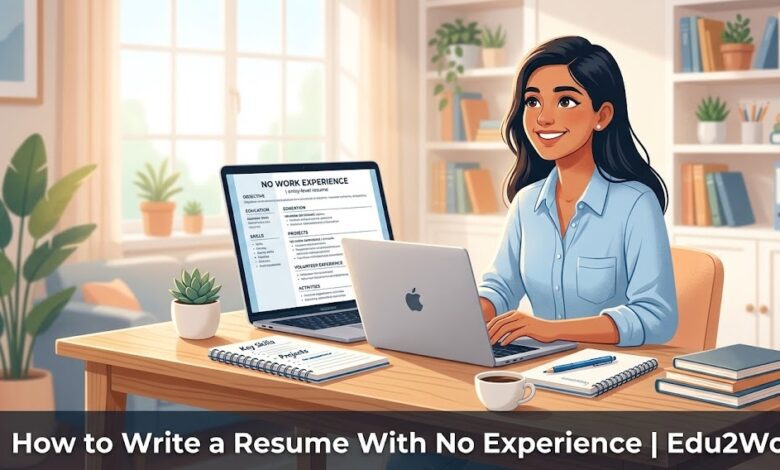
How to Write a Resume With No Work Experience
in 2026: A Complete Student Guide
Writing your first resume is one of the most
stressful experiences for any student or fresh graduate.
You open a blank document, stare at it for ten minutes,
and then ask yourself the same question that millions
of students have asked before you —
“What do I even put on this thing
if I have never worked before?”
Here is the truth that most people do not tell you.
A resume with no work experience is not a bad resume.
It is simply a different kind of resume —
one that requires a different approach,
a different structure, and a different
way of thinking about what actually
qualifies as valuable experience.
And once you understand that approach,
you will realize you have much more
to offer than you think.
This guide is going to walk you through
everything you need to know about writing
a strong, professional resume as a student
or recent graduate with little to no
formal work experience.
We will cover what to include,
how to format it, what mistakes to avoid,
and how to make employers genuinely
interested in meeting you —
even when you are competing
against people with more experience.
Why a No-Experience Resume is NOT a Dead End
Before we get into the practical steps,
let us change the way you think about
your situation. Many students feel
embarrassed or discouraged when they
do not have work experience to list
on their resume. But consider this —
every single person who has ever had
a job started somewhere.
Every experienced professional you admire
once submitted their very first resume
with nothing impressive on it.
Employers who post entry-level positions
and internships already know they are
going to receive applications from people
with limited experience.
They are not expecting ten years
of work history from a 21-year-old.
What they are looking for is potential,
attitude, relevant skills,
and signs that this person will learn
quickly and contribute meaningfully
to their team.
Your job in writing your resume
is not to hide your lack of experience.
It is to showcase everything else
you have that makes you a strong candidate —
your education, your projects,
your skills, your extracurricular activities,
your certifications, and your personal qualities.
When presented correctly,
these elements can be just as compelling
as years of work experience.
What to Include in a Student Resume
With No Work Experience
The structure of your resume will look
a little different from a traditional
professional resume. Here is what you
should focus on and in what order
of priority:
1. Contact Information
This seems obvious, but you would be
surprised how many students make
mistakes here. Your contact section
should include your full name
(in a slightly larger font than the rest),
your professional email address,
your phone number, your city and country,
and a link to your LinkedIn profile
if you have one.
A very important point about your email address —
make sure it looks professional.
An address like coolguy2005@gmail.com
or prettyprincess@yahoo.com
will immediately make you look unprofessional.
Create a new email with just your name —
something like john.ahmed@gmail.com
or sarah.malik@outlook.com.
This small detail matters more than you think.
2. A Strong Personal Summary or Objective Statement
Right below your contact information,
write a 3 to 4 sentence summary
that introduces you to the employer.
This is your first impression —
your chance to grab their attention
before they read anything else.
Your summary should mention who you are
(your field of study and academic level),
what you are good at or passionate about,
and what kind of opportunity you are looking for.
Keep it confident but honest.
Do not use vague phrases like
“hardworking team player seeking opportunities.”
Instead, be specific about your
skills and your goals.
Here is an example of a weak summary
versus a strong one:
| Weak Summary | Strong Summary |
|---|---|
| “I am a hardworking student looking for a job where I can use my skills and grow professionally.” |
“Final-year Business Administration student with strong skills in digital marketing and content creation. Completed Google’s Digital Marketing Certificate and built an Instagram page with over 2,000 followers for a local clothing brand as a volunteer project. Looking to contribute these skills in a marketing internship or entry-level role.” |
See the difference? The strong version
is specific, shows real proof,
and gives the employer a clear picture
of who you are and what you bring.
Always write your summary with this
level of specificity.
3. Education Section
For students with no work experience,
the education section should come
right after your summary —
not at the bottom as it would
in a traditional professional resume.
Your academic background is your
primary credential right now,
so give it the prominence it deserves.
In your education section, include:
- Your degree name and field of study
- Your university or college name
- Your expected graduation date
(or graduation date if already completed) - Your GPA or percentage
(only if it is strong — generally above 3.0
or 70% — otherwise leave it out) - Relevant coursework —
list 4 to 6 courses that are
directly related to the job you are applying for - Academic achievements,
scholarships, or honors if any
4. Skills Section
This is one of the most important sections
on a no-experience resume.
Skills give employers a quick snapshot
of what you are technically capable of.
Divide your skills into two categories
— hard skills and soft skills.
Hard skills are specific,
teachable abilities like graphic design,
Python programming, video editing,
data analysis, SEO, or proficiency
in Microsoft Office tools.
These are skills you can demonstrate
or prove through work samples or certifications.
Soft skills are personal
qualities like communication,
time management, leadership,
and problem-solving.
Be careful not to just list generic
soft skills without any context.
Instead of just writing “leadership,”
briefly mention somewhere on the resume
a specific example of when you
demonstrated that quality —
such as leading a university project
or organizing an event.
| Hard Skills Examples | Soft Skills Examples | Tools/Software Examples |
|---|---|---|
| Content Writing | Team Leadership | Microsoft Office Suite |
| Graphic Design | Problem Solving | Adobe Photoshop |
| Social Media Marketing | Time Management | Canva |
| Data Analysis | Communication | Google Analytics |
| SEO Basics | Adaptability | WordPress |
| Video Editing | Critical Thinking | Figma |
5. Projects Section —
Your Secret Weapon
If you have no work experience,
your projects section becomes
the most powerful part of your resume.
This is where you can show employers
real evidence of your skills and
initiative — things you have built,
created, organized, or contributed to,
even outside of any formal job.
What counts as a project
on a student resume?
- A website or app you built
as part of a course or independently - A research paper or thesis
you worked on at university - A social media page
or blog you manage - A video series or YouTube channel
you created - A business or entrepreneurial
idea you developed, even if small - A community service project
you organized or participated in - A design portfolio of logos
or graphics you created - A data analysis project
done for a class assignment
For each project, write 2 to 3 bullet points
that describe what you did,
what tools or skills you used,
and what the outcome or result was
if measurable.
For example:
“Designed and managed a social media
marketing campaign for a local bakery
as a volunteer project,
growing their Instagram following
from 200 to 1,400 in 8 weeks
using organic content strategies.”
Results like that are impressive
to any employer —
and they cost you nothing to achieve
except time and effort.
6. Certifications and Online Courses
In 2026, online certifications carry
real weight with employers —
especially when they come from
recognized platforms and organizations.
List any relevant certifications
you have earned, including the
name of the certification,
the issuing organization,
and the year you completed it.
Some highly recognized free
certifications you can earn right now
include:
- Google Digital Marketing
and E-Commerce Certificate
— Coursera (Free to audit) - HubSpot Content Marketing
Certification —
HubSpot Academy (Free) - Google Data Analytics
Certificate — Coursera - Meta Social Media
Marketing Certificate — Coursera - Microsoft Office Specialist
Certification - Coursera Python for Everybody
— University of Michigan - LinkedIn Learning Certificates
— Wide range of topics
7. Extracurricular Activities
and Volunteer Work
University life offers many opportunities
beyond the classroom —
student clubs, sports teams,
debate societies, volunteer programs,
community organizations,
and cultural events.
If you have been involved in any of these,
include them on your resume
because they demonstrate important
qualities like teamwork, initiative,
time management, and leadership.
Be specific about your role
and what you contributed.
Instead of just writing
“Member of Marketing Club,”
write “Marketing Club —
Event Coordinator:
Organized three on-campus events
with an average attendance of 150 students,
managing budgets and promotional materials.”
8. Languages
If you speak more than one language,
always include this on your resume.
In many industries and companies —
especially those with international
clients or operations —
being bilingual or multilingual
is a genuine competitive advantage.
List each language and your level:
Native, Fluent, Professional,
or Basic.
Resume Formatting Tips
That Make a Big Difference
Content is king, but formatting
is what makes your content readable
and professional. Poor formatting
can cause a great resume to be ignored.
Here are the formatting rules
you should follow:
- Keep it to one page:
As a student with no experience,
one page is the right length.
Hiring managers spend an average
of 6 to 7 seconds on an initial
resume scan — make every word count. - Use a clean, simple font:
Stick to professional fonts like
Calibri, Arial, Garamond, or Georgia.
Font size should be 10 to 12 points
for body text and slightly larger
for your name and section headings. - Use consistent spacing:
Make sure margins are even,
section headers are clearly distinct,
and bullet points are aligned properly. - Use bullet points
not paragraphs:
In the experience, projects,
and activities sections,
use short bullet points
rather than long paragraphs.
They are easier to scan quickly. - Use action verbs:
Start each bullet point with
a strong action verb —
words like Created, Managed, Designed,
Developed, Organized, Led,
Analyzed, Wrote, Built, Increased. - Save as PDF:
Always submit your resume as a PDF
unless the employer specifically
asks for a Word document.
PDF ensures your formatting
stays intact on any device. - Choose a professional
color scheme:
A touch of color in your headers
(navy blue, dark green,
or dark grey) can make your
resume stand out slightly
without being distracting.
Avoid bright, flashy colors
in most industries.
Resume Templates —
Free Tools You Can Use Right Now
You do not need to hire a designer
or spend money to create
a professional-looking resume.
These free tools offer excellent
templates that are clean,
ATS-friendly (more on that next),
and easy to customize:
| Tool | Cost | Best Feature |
|---|---|---|
| Canva | Free (Pro optional) | Beautiful visual templates, easy to use |
| Novoresume | Free basic version | ATS-optimized, professional layouts |
| Zety | Free to create, paid to download | Content suggestions included |
| Resume.io | Free basic version | Clean modern designs |
| Google Docs Templates | Completely Free | Simple, reliable, ATS-safe |
| Microsoft Word Templates | Free with Office | Widely accepted format |
What is ATS and Why Should
Student Applicants Care?
ATS stands for Applicant Tracking System.
It is software that many companies —
especially larger ones —
use to automatically scan and filter
resumes before a human ever reads them.
The ATS scans your resume
for specific keywords related
to the job description
and ranks applications accordingly.
Resumes that do not contain
the right keywords get filtered out
automatically, even if the candidate
is actually qualified.
This means that tailoring your resume
to each job application is not
just a good idea —
it is essential.
Read the job description carefully,
identify the key skills and qualifications
they are asking for,
and make sure those exact words
appear naturally in your resume
where they are truthfully applicable.
For ATS compatibility,
also avoid using tables,
text boxes, graphics,
or unusual fonts in your resume layout.
These elements confuse ATS software
and can cause your resume
to be parsed incorrectly.
Stick to a clean, simple,
text-based format for
maximum ATS compatibility.
Common Resume Mistakes
Students Make
- Using one generic resume
for every job:
Customize your resume for each
application based on the specific
job requirements. - Listing responsibilities
instead of achievements:
Do not just say what you did —
say what you achieved or contributed.
Numbers and results make
bullet points much stronger. - Including a photo
on your resume:
In most Western countries
and international companies,
including your photo on a resume
is not recommended and can
actually create bias issues.
Research the norms in your specific country. - Adding irrelevant personal information:
Your age, marital status, religion,
and nationality should generally
not be on your resume unless
specifically required in your country. - Spelling and grammar errors:
Even one spelling mistake
can disqualify you from consideration.
Proofread your resume multiple times
and use tools like Grammarly
to catch errors. - Making it too long:
As a student, keep it to one page.
Trying to fill two pages
with irrelevant content
just makes it harder to read
and less impressive. - Using an outdated format:
The objective-style resume
from ten years ago is outdated.
Use a modern summary statement
and skills-forward format instead.
A Quick Resume Checklist
Before You Submit
- ✅ Professional email address used
- ✅ Strong personal summary written
- ✅ Education section clearly presented
- ✅ Relevant skills listed
(both hard and soft) - ✅ At least 2 to 3 projects included
with specific details - ✅ Certifications listed
with issuing organization - ✅ Extracurricular activities included
- ✅ Action verbs used
to start bullet points - ✅ No spelling or grammar mistakes
- ✅ Saved as PDF
- ✅ One page in length
- ✅ Customized for this specific job
- ✅ Keywords from job description included
Frequently Asked Questions (FAQs)
Q1: Should I include my high school
education on my university resume?
If you are currently in university
or have recently graduated,
there is no need to include
high school information
unless you had exceptional achievements
there — like national level awards
or competitions.
Your university education
is the relevant credential now.
Q2: Can I include group projects
from university on my resume?
Yes, absolutely.
Group university projects
are completely valid to include,
especially if your contribution was significant.
Be clear about what your
specific role and contribution was
within the group project
rather than describing
what the group did overall.
Q3: Is a cover letter necessary
when I have no experience?
A cover letter is highly recommended
when you have no experience
because it gives you space
to explain your motivation,
your relevant skills,
and why you are genuinely
interested in that specific
company and role.
A well-written cover letter
can make a significant difference
in whether you get
called for an interview.
Q4: How do I explain gaps
in my resume?
If you have gaps in your timeline,
do not try to hide them.
Instead, briefly address them honestly —
either in your cover letter
or in an interview.
Many employers respect candidates
who are transparent and
who used their time productively,
even if not in a formal job.
Q5: Should I use a resume template
or create my own design?
Using a clean, professional template
is perfectly fine —
especially for your first resume.
Just make sure it is ATS-compatible
and not overly designed with
graphics or unusual layouts.
As you advance in your career,
you can develop a more
personalized resume style.
Conclusion: Your Resume is
Just the Beginning
Writing your first resume without
work experience feels challenging,
but it is a challenge you can
absolutely overcome with
the right approach.
The key is to shift your perspective —
stop thinking about what you do not have
and start focusing on everything
you already bring to the table:
your education, your projects,
your skills, your certifications,
your activities, and your potential.
Remember that every employer
who hires students and fresh graduates
is making a bet on potential,
not just past experience.
Your job is to show them —
through a clear, well-structured,
and honest resume —
that you are worth taking
that bet on.
Take the time to build your resume properly.
Customize it for each application.
Keep improving it as you gain
more skills and experience.
And never stop working on
building the skills and portfolio pieces
that will make your next resume
even stronger than this one.
More Helpful Articles on Edu2Work:
- Best High Income Skills for Students in 2026
- How to Start Freelancing as a Student
With No Experience - How to Prepare for a Job Interview
as a Fresh Graduate - Top Online Certifications That
Employers Actually Value in 2026 - How to Write a Cover Letter
That Gets You Noticed