
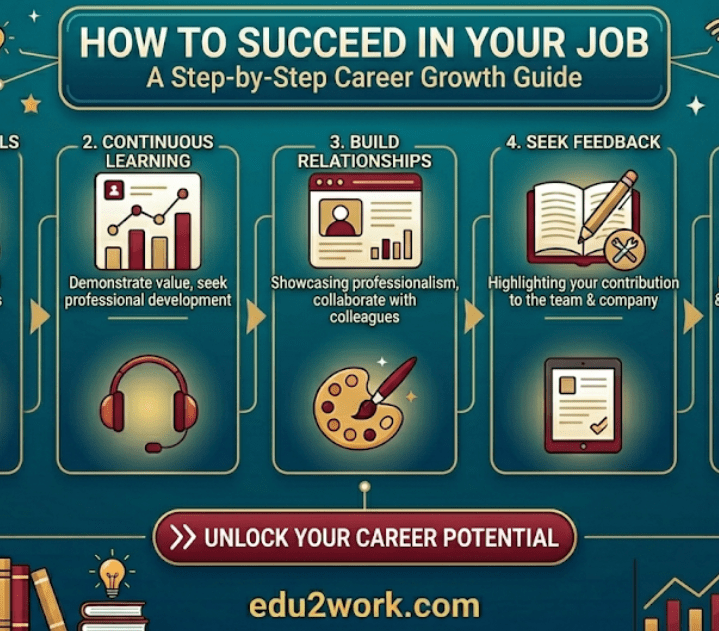
How to Succeed in Any Job in 2026: Proven Tips, Habits and Strategies That Actually Work
📂 Category: Jobs & Careers |
⏱️ Read Time: ~12 Minutes |
✍️ Editorial Team
📣 Share This & Help Someone Grow in Their Career:
🐦 Twitter / X |
✈️ Telegram |
Getting a job is one thing. Actually succeeding in it — growing,
earning more, being respected, getting promoted, and genuinely
enjoying what you do — is a completely different challenge. And
it is one that nobody properly prepares you for.
Schools teach you subjects. Universities teach you theories.
But almost nobody teaches you how to actually thrive
inside a workplace. How to handle a difficult manager. How to
make yourself genuinely valuable. How to communicate in ways
that get you noticed for the right reasons. How to grow when
the path forward is not obvious.
That is what this guide is for. Whether you just started your
first job, have been working for a few years and feel stuck,
or want to accelerate your career growth in 2026 — these are
the strategies that actually work. Not motivational fluff.
Not generic advice you have heard a hundred times. Real,
practical, specific things you can start doing this week.
Why Most People Never Reach Their Full Potential at Work
Before we talk about what to do, let’s be honest about why
so many capable people underperform relative to their actual ability.
- They confuse being busy with being productive:
Filling every hour with tasks gives a feeling of progress
without necessarily creating real value. Busyness is not
the same as impact. - They wait to be noticed instead of making themselves visible:
Hard work alone does not get you promoted. Hard work that
the right people see and understand gets you promoted.
There is a difference. - They stop learning after joining: Many
employees treat their first job as the finish line rather
than the starting line. In a rapidly changing workplace,
the moment you stop growing is the moment you start falling behind. - They avoid difficult conversations: Problems
with colleagues, unclear expectations, feeling undervalued —
these things rarely resolve themselves. Avoiding difficult
conversations is almost always more costly than having them. - They focus on the wrong relationships: Many
people either ignore workplace relationships entirely or spend
energy on the wrong connections. Strategic relationship-building
is one of the most powerful career tools available — and most
people never use it deliberately.
Recognizing these patterns in yourself is the first step toward
breaking them. Let’s now get into the specific strategies.
Tip 1: Master the First 90 Days — They Define Everything
The first three months in any new job are disproportionately
important. Research shows that the impressions formed during
this period are remarkably sticky — they shape how colleagues
and managers perceive you for years. Make them count.
What to Do in Your First 90 Days
- Listen far more than you speak: Resist the
urge to immediately share ideas and suggestions. Spend the
first 30 days primarily observing, listening, and understanding
how things actually work — not how they look on paper. Every
organization has an unofficial culture, unwritten rules, and
informal power structures that you cannot see from the outside. - Understand what success means in this specific role:
Have an explicit conversation with your manager within the
first two weeks. Ask directly: “What does success look like
in this role at 30, 60, and 90 days?” This single conversation
prevents months of working hard in the wrong direction. - Build relationships across the organization:
Don’t limit yourself to your immediate team. Introduce yourself
to people in other departments. Have coffee with colleagues
at different levels. The more people who know who you are
and what you contribute, the more secure and visible your
position becomes. - Deliver one early win: Identify one task,
project, or problem where you can demonstrate clear value
within the first month. This doesn’t need to be dramatic —
just concrete, visible, and done well. Early wins establish
credibility that takes much longer to build through consistent
average performance.
Tip 2: Develop the Skill Nobody Talks About — Managing Up
Managing up means actively managing your relationship with your
manager — understanding what they need, communicating in ways
that work for them, and making their job easier by being genuinely
dependable and proactive.
This is not flattery or politics. It is a professional skill
that dramatically affects how far and how fast you progress in
any organization.
How to Manage Up Effectively
- Understand your manager’s priorities and pressures:
What are they being held accountable for? What keeps them
up at night? When your work directly reduces their stress
and helps them succeed, you become genuinely valuable —
not just technically competent. - Communicate proactively — never let them be surprised:
If a deadline is at risk, tell your manager early. If you
encounter an obstacle, flag it with a proposed solution.
Managers hate surprises. Employees who keep them informed
and never leave them scrambling build exceptional trust quickly. - Adapt to their communication style: Some
managers want detailed written updates. Others prefer a
quick verbal summary. Some want to be involved in decisions;
others want you to handle things independently and just
report outcomes. Pay attention and adapt. - Bring solutions, not just problems: When you
raise an issue, bring at least one potential solution with it.
This signals initiative, saves your manager’s time, and
positions you as someone who thinks beyond their own task list.
Tip 3: Become Known for One Thing — Then Expand
In a crowded workplace, generalists often get overlooked.
The employees who get noticed, promoted, and sought after
are usually those who are known for being exceptional at
something specific.
This doesn’t mean staying in a narrow box forever. It means
strategically building a reputation for excellence in one
area first — then expanding from that foundation.
For example: if you are known as the person who always
produces the clearest data reports, that reputation gives
you visibility and credibility. From there, you can expand
into presenting those reports, then advising on strategy
based on the data, then leading projects that depend on
data-driven decision-making. One expertise becomes a platform.
How to Identify Your Signature Strength
- What do colleagues ask you for help with most often?
- What tasks do you complete faster and better than most people around you?
- What work do you lose track of time doing because you are genuinely engaged?
- What has your manager specifically praised you for?
The intersection of what you are good at, what your organization
needs, and what you enjoy is where your professional brand lives.
Find it — then invest in it deliberately.
Tip 4: Communicate Like a Senior Professional — From Day One
One of the fastest ways to accelerate your career is to communicate
the way people at the level above you communicate — even before
you reach that level. This signals readiness for more responsibility.
Communication Habits That Set You Apart
- Write emails that are clear, concise, and action-oriented:
Put the key point or request in the first sentence. Use short
paragraphs. State clearly what you need and by when. Busy
professionals make rapid judgments about people based on
how well they communicate in writing. - Speak up in meetings — thoughtfully:
Employees who never contribute in group settings become
invisible. But employees who speak frequently without adding
value become irritants. The goal is to contribute once or
twice per meeting with something specific, relevant, and
considered. Quality over quantity. - Give feedback graciously: When asked for
your opinion on a colleague’s work or idea, be honest but
constructive. Vague positivity helps no one. Specific,
respectful feedback builds trust and marks you as someone
with genuine professional judgment. - Receive feedback without defensiveness:
This is harder than it sounds. When your manager or a
colleague gives you critical feedback, your instinct may
be to explain or defend. Resist it. Listen completely,
ask clarifying questions, thank them genuinely, and then
act on it. Employees who receive feedback well get more
of it — and feedback is one of the fastest drivers of growth.
Tip 5: Never Stop Learning — Make It a Daily Habit
The workplace of 2026 is changing faster than any previous
generation has experienced. Skills that were cutting-edge
three years ago are already becoming standard. Skills that
are standard today may be partially automated within five years.
The employees who succeed long-term are those who treat
learning as a daily professional responsibility — not
something they do when forced to by a job requirement.
How to Build a Daily Learning Habit
- Dedicate 30 minutes per day to deliberate learning:
Before work, during lunch, or after hours — this small
daily investment compounds dramatically over months and years. - Read industry publications and newsletters:
Staying current with trends in your field makes you a more
valuable contributor in any conversation and signals genuine
professional engagement. - Take online courses strategically:
Identify the skills most valued in roles one level above
yours. Then start building those skills now — before you
need them — so that when the opportunity arises, you are
already prepared. - Learn from the people around you:
Your experienced colleagues are a vastly underused learning
resource. Ask questions. Ask them what they wish they had
known earlier in their careers. Ask them how they approach
complex problems. Most experienced professionals are
genuinely happy to share — when asked respectfully.
| Skill to Learn | Why It Matters in 2026 | Where to Learn It | Time Investment |
|---|---|---|---|
| Data Analysis (Excel/SQL) | Every industry runs on data now | Coursera, YouTube, LinkedIn Learning | 4–8 weeks |
| AI Tools (ChatGPT, Copilot) | Productivity multiplier across all roles | YouTube, Official Docs, Practice | 1–2 weeks |
| Project Management | Every team needs organized leaders | PMI, Coursera, Google Certificate | 6–10 weeks |
| Public Speaking | Visibility and influence depend on it | Toastmasters, YouTube, Practice | Ongoing |
| Emotional Intelligence | The #1 predictor of leadership success | Books, Coaching, Self-reflection | Ongoing |
| Negotiation Skills | Affects salary, resources, and influence | Books, Coursera, Role-play practice | 3–4 weeks |
Tip 6: Build Your Professional Reputation Intentionally
Your professional reputation is what people say about you
when you are not in the room. It is built slowly through
hundreds of small interactions and decisions — and it is
one of your most valuable career assets.
Reputation-Building Habits That Work
- Always do what you say you will do:
Reliability is rarer than talent. If you commit to a
deadline, meet it. If you say you will follow up, follow up.
If you cannot deliver something, say so early — never
let people down silently. - Give credit generously: When a team
succeeds, publicly acknowledge the contributions of others.
Leaders who share credit are trusted and followed.
People who claim group successes as personal achievements
are resented — even when those around them say nothing. - Be known as a problem-solver: When
something goes wrong — and it will — focus first on
solving it rather than explaining why it is not your
fault. The employee who calmly works through problems
under pressure becomes genuinely indispensable. - Help colleagues without keeping score:
Generosity with your time, knowledge, and connections
builds goodwill that returns to you in ways that are
difficult to predict but consistently powerful.
Tip 7: Handle Workplace Conflicts Like a Professional
Every workplace has conflict. Colleagues who disagree.
Managers who are difficult. Situations that feel unfair.
How you handle these moments says more about your professional
maturity than almost anything else.
A Framework for Handling Workplace Conflict
- Pause before reacting: When something
upsets you at work, resist the urge to respond immediately.
Give yourself 24 hours if possible. Emotional reactions
— especially in writing — are almost always regretted. - Address issues directly and privately first:
If you have a problem with a colleague, speak to them
directly in private before involving a manager. Most
workplace conflicts are rooted in misunderstanding rather
than genuine malice — and a direct, respectful conversation
resolves them faster than escalation. - Focus on the issue, not the person:
“The deadline was missed” is a workable problem.
“You are disorganized and unreliable” is an attack that
creates defensiveness and resolves nothing. - Know when to escalate: If direct conversation
doesn’t resolve the issue, or if the situation involves
harassment, discrimination, or serious misconduct, escalate
to HR or senior management with a calm, factual account
of what has happened. - Never make it personal publicly:
Complaining about colleagues or managers to others in
the workplace almost always backfires. What feels like
venting is often perceived as gossiping — and damages
your reputation far more than the person you are complaining about.
Tip 8: Ask for What You Want — Promotions and Raises Don’t Just Happen
This is where many hardworking, talented people make a
critical mistake. They assume that if they work hard enough
and long enough, recognition and reward will come automatically.
Sometimes it does. More often it doesn’t.
The employees who advance fastest are almost always the ones
who advocate for themselves clearly and professionally. They
have explicit conversations about their career goals. They
ask what is required for promotion. They negotiate their
salaries confidently. They request the projects and
opportunities that will develop them.
How to Ask for a Promotion
- Document your achievements first: Keep a
running record of every significant contribution, project
outcome, problem solved, and piece of positive feedback
you receive. When the time comes to make your case,
you need specific evidence — not vague claims. - Choose the right moment: After a successful
project, during a performance review, or at the start of
a new budget cycle — not during a period of organizational
stress or your manager’s peak workload. - Frame it as a conversation, not a demand:
Ask your manager what it would take for you to move to
the next level. What skills do you need to develop?
What results would demonstrate readiness? This positions
you as ambitious but coachable — and gives you a clear
roadmap. - Be patient after asking — but follow up:
Career advancement rarely happens in a single conversation.
After expressing your goals, act on the feedback you receive
and revisit the conversation 3–6 months later with evidence
of progress.
Read more: How to Negotiate Your Salary in 2026 — Scripts and Strategies
Tip 9: Protect Your Energy and Avoid Burnout
You cannot sustain high performance if you are consistently
running on empty. Burnout is not a sign of weakness — it is
a predictable physiological and psychological response to
sustained stress without sufficient recovery. And in 2026,
with the boundaries between work and personal life increasingly
blurred by remote and hybrid arrangements, it is more common
than ever.
Sustainable High Performance Habits
- Set clear work boundaries: Define when
your workday ends and protect that boundary consistently.
Respond to non-urgent messages during work hours only.
The always-available employee is not impressive — they
are unsustainable. - Take your breaks and holidays: Research
consistently shows that employees who take regular breaks
and use their annual leave are more productive — not less.
Rest is not wasted time. It is maintenance. - Recognize early warning signs of burnout:
Chronic fatigue, cynicism about your work, reduced
concentration, irritability, and a sense of ineffectiveness
are all warning signals. Act on them early — not after
they become a crisis. - Invest in physical health: Regular exercise,
adequate sleep, and reasonable nutrition are not lifestyle
luxuries — they are professional performance tools. The
research on this is overwhelming and consistent.
Tip 10: Think Like an Owner — Not Just an Employee
The single mindset shift that separates employees who plateau
from those who consistently advance is this: thinking like
an owner rather than a task-completer.
An employee thinks: “I was asked to do X. I did X. My job is done.”
An owner thinks: “X is done. Does it actually solve the problem?
Is there a better approach? What comes next? How does this connect
to the bigger goal?”
You don’t need to own the company to think this way. You just
need to genuinely care about the outcomes of your work — not just
the completion of your tasks. Employees who think this way get
noticed, trusted, given more responsibility, and promoted.
Consistently. Across every industry and organization type.
Quick Reference: Daily Habits of Highly Successful Employees
| Habit | Frequency | Impact |
|---|---|---|
| Plan tomorrow’s priorities tonight | Daily | 🟢 Very High |
| Spend 30 mins learning something new | Daily | 🟢 Very High |
| Send one genuine appreciation to a colleague | Weekly | 🟢 High |
| Review your achievements and update records | Monthly | 🟢 High |
| Have a career conversation with your manager | Quarterly | 🟢 Very High |
| Attend one industry event or webinar | Monthly | 🟢 High |
| Review and update LinkedIn profile | Quarterly | 🟢 High |
| Ask for feedback from manager or mentor | Monthly | 🟢 Very High |
Frequently Asked Questions (FAQ)
Q1: How do I deal with a manager who never gives me feedback?
This is extremely common and genuinely frustrating. The solution
is to stop waiting and start asking. Schedule a regular
one-on-one meeting with your manager — even monthly —
specifically for feedback and career discussion. Come prepared
with specific questions: “What is one thing I could have done
better on the recent project?” or “What skill do you think
would make me most effective in this role?” Managers who don’t
volunteer feedback often respond well when asked directly —
they simply haven’t prioritized it. If your manager consistently
refuses to engage even when asked, that is important information
about whether this environment can support your growth.
Q2: I feel completely stuck in my current role — what should I do?
Feeling stuck is one of the most common career experiences —
and one of the most uncomfortable. First, diagnose the cause
honestly. Are you stuck because you have genuinely plateaued
and there is no path forward in this organization? Or are you
stuck because you haven’t actively created opportunities?
Talk to your manager about your career goals — many employees
are surprised to discover there are paths forward they hadn’t
been aware of. If after honest exploration the organization
genuinely cannot offer you growth, it may be time to look
externally. Staying in a role where growth is impossible
is a cost — even if the salary feels comfortable.
Q3: How do I stand out when everyone around me seems equally capable?
In most workplaces, technical competence is table stakes —
the minimum required to stay in the game. What differentiates
people at similar competence levels is almost always
behavioral: reliability, communication quality, attitude
under pressure, initiative, and genuine investment in the
team’s success. Find the intersection of what the organization
needs most and what you do better than most around you —
then make that your visible specialty. Also consider that
“standing out” is partly about visibility. Doing excellent
work in silence is not enough — find appropriate ways to
ensure the right people know about your contributions.
Q4: Is it okay to job hop if I am not growing in my current role?
In 2026 — yes, far more than in previous generations.
The stigma around job changes has reduced significantly
as employers have accepted that career paths are no longer
linear. Changing jobs strategically — for better growth
opportunities, higher compensation, or more meaningful
work — is widely accepted provided you have spent a
reasonable amount of time in each role (generally a minimum
of 12–18 months). What employers look for is a coherent
narrative: that each move makes sense as part of a
deliberate career progression rather than random
instability or chronic dissatisfaction.
Q5: How do I build a strong professional network without feeling fake?
The key insight is this: networking that feels fake usually
is fake — and people can tell. Genuine professional networking
is not about collecting contacts. It is about building real
relationships with people whose work you respect and find
interesting. Start by engaging authentically with content
people share on LinkedIn — comment thoughtfully rather
than just liking. Attend events related to topics you
genuinely care about. Offer value before asking for it —
share useful articles, make introductions, congratulate
people on real achievements. When networking feels like
connecting with interesting people around shared interests
rather than collecting business cards, it stops feeling
fake — because it is no longer fake.
Conclusion: Success at Work Is a Daily Choice
Career success in 2026 is not a single dramatic decision.
It is hundreds of small daily choices — to learn something
new, to communicate one degree more clearly, to help a
colleague without being asked, to raise your hand for a
challenging project, to have the difficult conversation
you have been avoiding.
None of the tips in this guide require extraordinary talent
or exceptional luck. They require consistency, self-awareness,
and the willingness to treat your career as something worth
actively managing rather than passively experiencing.
The most successful professionals you admire did not get
there by accident. They made deliberate choices — often
invisible ones — day after day, year after year.
That is available to you too.
Start with one thing from this guide. Apply it this week.
Then add another. Your career is a long game — and the
best time to start playing it seriously is right now.
| 🔔 Get Daily Career Tips, Job Alerts & Growth Strategies — Completely Free Join thousands of professionals and students who get 💬 Join Our WhatsApp Group: 👍 Follow Our Facebook Page: |
📣 Found This Helpful? Share It With Someone Who Needs It:
🐦 Twitter / X |
✈️ Telegram |
Read more: Top 10 Remote Jobs for Freshers in 2026
|
How to Write a CV That Gets Interviews in 2026
|
Best Free Certifications to Boost Your Career in 2026


