
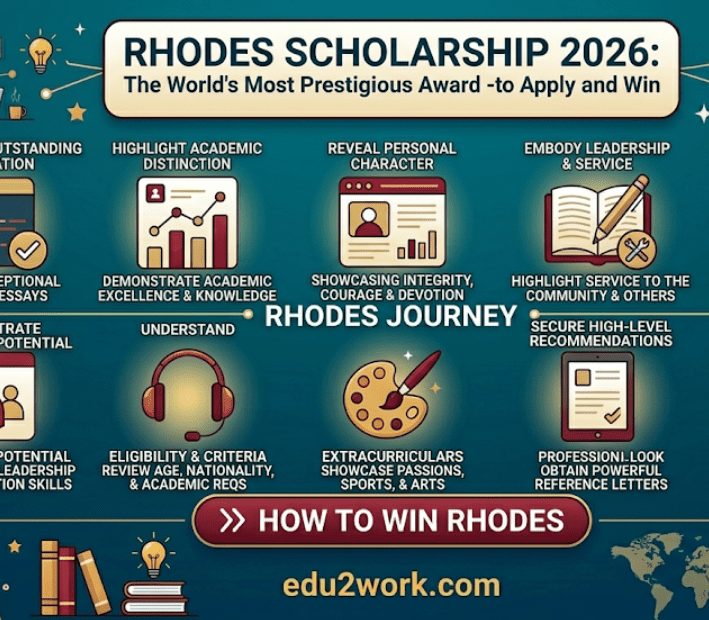
Rhodes Scholarship 2026: The World’s Most Prestigious Award — Complete Guide to Apply and Win
📂 Category: Scholarships |
⏱️ Read Time: ~12 Minutes |
✍️ Editorial Team
📣 Share This & Help a Student Reach Oxford:
🐦 Twitter / X |
✈️ Telegram |
There are scholarships. And then there is the Rhodes Scholarship.
Founded in 1902 through the will of British businessman and statesman
Cecil Rhodes, the Rhodes Scholarship is the oldest and most celebrated
international scholarship program in the world. It sends exceptional
young people from across the globe to study at the
University of Oxford — one of the most respected
academic institutions in human history — with every expense covered
and a lifetime membership in one of the most powerful professional
networks on earth.
Rhodes Scholars have gone on to become presidents, prime ministers,
Nobel Prize laureates, Supreme Court justices, CEOs of global
corporations, celebrated authors, pioneering scientists, and
transformative social leaders. The list of what Rhodes Scholars
have achieved collectively is genuinely staggering.
But here is what this guide is going to show you clearly:
the Rhodes Scholarship is not reserved for a mythical
category of superhuman candidates. It is won by real
people — people who understood what the scholarship was looking
for, built their candidacy deliberately, and communicated their
story with honesty, precision, and conviction.
That is exactly what we are going to help you do today.
What Is the Rhodes Scholarship — And What Does It Actually Cover?
The Rhodes Scholarship funds postgraduate study at the
University of Oxford in the United Kingdom.
It is awarded annually to students from a growing list of
countries and constituencies around the world.
Here is what a Rhodes Scholarship covers in full:
- ✅ Full tuition fees at the University of Oxford
for the duration of your program - ✅ Monthly stipend of approximately £1,800–£2,000
to cover living expenses in Oxford - ✅ Return airfare from your home country to the UK
at the start and end of your scholarship - ✅ Oxford college membership — giving you access
to dining, libraries, social events, and the full Oxford collegiate experience - ✅ Rhodes House community — access to events,
speakers, and a global network of scholars past and present - ✅ Personal and professional development support
throughout your time at Oxford
The scholarship typically funds one or two years of study,
depending on the program. Extensions are sometimes granted for
doctoral research.
Who Can Apply — Eligibility Explained Clearly
Rhodes Scholarships are awarded through specific constituencies —
essentially geographic regions or countries. Eligibility depends
on which constituency you belong to. As of 2026, the program
covers the following major constituencies:
| Constituency | Countries / Regions Included | Scholarships Per Year |
|---|---|---|
| United States | USA (by state districts) | 32 |
| Commonwealth Africa | South Africa, Zimbabwe, Zambia, Kenya, Ghana, Uganda, others | Varies by country |
| Australia & Pacific | Australia, New Zealand, Pacific Islands | ~10 |
| Canada | Canada (by province) | 11 |
| India | India | 6 |
| China | China (incl. Hong Kong) | 6 |
| Middle East & North Africa | Egypt, Jordan, Lebanon, Syria, Palestine, others | Varies |
| Global (at-large) | Countries not in other constituencies | Varies |
The Rhodes Trust has significantly expanded its geographic reach
in recent years and continues to add new constituencies. If your
country is not listed above, check the official Rhodes Scholarship
website — you may qualify through a global or regional constituency.
Core Eligibility Requirements
- Age: Most constituencies require candidates
to be between 18 and 28 years old at the
time of application. Check your specific constituency. - Education: Must have completed or be in the
final year of a bachelor’s degree with an outstanding academic record. - Citizenship/Residency: Must be a citizen or
permanent resident of your applying constituency. Requirements
vary — check carefully. - Character: Demonstrable integrity, commitment
to service, and moral leadership — Cecil Rhodes was explicit
about this in his original will.
Read more: Full List of Rhodes Scholarship Eligible Countries and Constituencies
What Does the Rhodes Scholarship Actually Look For?
This is the question that separates candidates who apply randomly
from candidates who actually win. The Rhodes Scholarship does not
have a single checklist of requirements. It has a philosophy —
articulated in Cecil Rhodes’ original will — that guides every
selection decision.
Rhodes identified four qualities that define the ideal scholar:
1. Literary and Scholastic Attainments
Academic excellence matters — but not perfection. Rhodes Scholars
are expected to have demonstrated genuine intellectual ability and
curiosity. This means strong grades, yes — but also evidence that
you have engaged with ideas beyond the curriculum. Research experience,
published writing, thesis work, academic prizes, and intellectual
pursuits outside formal study all count here.
2. Energy to Use One’s Talents to the Full
The scholarship committee wants to see that you don’t just have
talent — you use it. Relentlessly, enthusiastically, and across
multiple domains. This is why Rhodes Scholars almost always have
a portfolio of achievements that extends well beyond academics.
Sports, arts, entrepreneurship, community organizing, research,
music, athletics — the specific domain matters less than the
evidence of sustained, passionate engagement.
3. Truth, Courage, Devotion to Duty, Sympathy and Kindness
Character. The Rhodes committee is deeply interested in who you
are as a person — not just what you have achieved. Do you treat
people with genuine respect and empathy? Have you shown moral
courage — stood up for something difficult, told an uncomfortable
truth, acted with integrity when it cost you something? These
qualities are explored in your essays and in depth during the interview.
4. Exhibition of Moral Force of Character and Instincts to Lead
Leadership is not about titles. It is about demonstrating that
people naturally follow your example, trust your judgment, and
that you have used whatever platform you have — however small or
large — to make things better for others. This could mean leading
a student union, coaching a youth sports team, founding a community
organization, or quietly mentoring younger students through
difficult times.
When you read through your application, ask yourself honestly:
does every section provide evidence of at least one of these
four qualities? If anything is missing, that is where to focus.
The Application Components — What You Need to Submit
While specifics vary slightly by constituency, most Rhodes Scholarship
applications require the following:
1. Personal Statement
This is typically your longest and most important essay. It should
tell the story of who you are, what has shaped you, what you care
about deeply, and where you are going. It should not read like a
CV in paragraph form. It should read like a conversation with a
genuinely interesting, self-aware, ambitious young person.
2. Proposed Course of Study at Oxford
You need to identify the specific Oxford program you wish to pursue
and explain clearly why Oxford is the right place to pursue it.
Name specific professors, research groups, or academic resources
at Oxford that are directly relevant to your goals. Generic
statements about Oxford’s prestige are meaningless here — specificity
is everything.
3. Academic Transcripts
Official transcripts from all universities attended. Strong academic
performance is expected — not perfection, but consistent excellence.
4. Reference Letters (Typically 4–6)
Rhodes requires more references than almost any other scholarship —
reflecting how seriously they take character assessment. Your
references should come from people who can speak to different
dimensions of who you are: academic ability, leadership, character,
service, and personal qualities.
5. CV / Resume
A comprehensive record of everything you have done — academic
achievements, work experience, research, publications, community
service, athletics, arts, languages, and leadership roles.
6. Constituency-Specific Requirements
Some constituencies require additional essays or supporting materials.
Always check the specific application requirements for your constituency
on the official Rhodes Trust website.
How to Write Your Personal Statement — The Make-or-Break Document
Let’s go deeper on the personal statement because this single document
carries enormous weight in the Rhodes selection process.
What Most Applicants Get Wrong
The most common mistake is writing a personal statement that reads
like an extended list of achievements. “I founded this club. I won
this award. I led this project.” Achievement lists are for your CV.
Your personal statement is for something far more important:
revealing who you actually are.
What a Strong Rhodes Personal Statement Does
- Opens with a moment, not a mission statement:
Begin with a specific scene, conversation, or realization that
captures something essential about your journey. Pull the reader
in before you tell them what you’ve accomplished. - Shows self-awareness: Acknowledges your limitations,
your failures, and what you learned from them. Rhodes committees
are deeply suspicious of applicants who present a flawless,
uncomplicated story. Life is complicated — your essay should
reflect that honestly. - Connects your past, present, and future coherently:
Show the committee a logical, authentic thread that runs from where
you came from to where you are going and why Oxford is the next
essential chapter. - Demonstrates the four Rhodes qualities: Without
using those words, your essay should provide evidence of
intellectual passion, energy, character, and leadership.
Use specific stories, not assertions. - Ends with genuine vision: Where are you going
beyond Oxford? What problem are you committed to working on?
What kind of leader do you intend to become? Be specific and
be ambitious — but also be honest.
Preparing for the Rhodes Interview
If you are shortlisted for a Rhodes Scholarship, you will be
invited to appear before a selection committee for a formal interview.
This is one of the most rigorous interviews you will ever experience
— and one of the most rewarding if you approach it correctly.
What the Interview Looks Like
Typically conducted by a panel of 5–8 committee members — often
including former Rhodes Scholars, academics, business leaders,
and public figures. The interview lasts approximately 15–20 minutes
and covers everything from your academic interests to current events,
your personal values, your leadership experiences, and your plans
beyond Oxford.
How to Prepare
- Know your application inside out: Every claim
you made in your essays is fair game for questioning. Be ready
to expand on, defend, and reflect critically on everything you wrote. - Stay current: Rhodes committees expect scholars
to be engaged citizens of the world. Read serious news sources
daily in the weeks before your interview. Be ready to discuss
current events in your field and globally. - Know your Oxford program deeply: Be able to
discuss specific aspects of your proposed course — modules,
research methodologies, faculty members, and how it connects
to your long-term goals. - Practice with difficult questions: Rhodes
interviewers are known for asking unexpected, challenging
questions to see how you think under pressure. Practice
with a mentor or trusted professor who will not go easy on you. - Be yourself — completely: The committee has
read your application. They know who you presented yourself
to be on paper. They are now checking whether that person
actually exists in the room. Authenticity is not a strategy
— it is the only approach that works.
Building Your Rhodes Candidacy — Starting Right Now
If you are reading this as a first or second-year undergraduate,
you have a genuine advantage: time. The students who win Rhodes
Scholarships rarely assembled their candidacy in a last-minute rush.
They built it deliberately, year by year, choice by choice.
Here is how to build your candidacy from wherever you are right now:
| Area | What to Build | How to Start |
|---|---|---|
| Academic Excellence | Strong GPA + research experience | Approach professors about research assistant roles |
| Leadership | Lead something meaningful — build something | Start or lead a student organization, initiative, or project |
| Service | Genuine, sustained community contribution | Volunteer consistently — not just once for your CV |
| Athletics / Arts | Excellence in at least one non-academic area | Commit deeply to a sport, instrument, or creative pursuit |
| Character | Demonstrated integrity and moral courage | Make hard, right choices — and be ready to talk about them |
| Global Awareness | Engagement with the world beyond your campus | Read widely, travel if possible, engage with international issues |
| Oxford Knowledge | Deep understanding of your target Oxford program | Research faculty, visit virtually, attend Oxford open days |
Read more: How to Build a Scholarship-Winning Profile From Year One
Common Mistakes That Cost Applicants the Rhodes
- ❌ Treating it as an academic award only:
Candidates who focus entirely on GPA and research ignore
the leadership and character dimensions that are equally
— sometimes more — important. - ❌ Generic essays that could apply to any scholarship:
Your Rhodes essays must be specifically about the Rhodes —
Oxford, the program, the scholars community, the specific
impact you intend to have. Recycled essays from other
scholarship applications are immediately obvious. - ❌ Weak or mismatched references: A glowing
reference from someone who barely knows you is worse than
a specific, honest reference from someone who has worked
closely with you. - ❌ Waiting until senior year to start thinking about it:
The strongest applications come from candidates who have been
building their profile intentionally throughout their undergraduate years. - ❌ Being inauthentic in the interview: Saying
what you think the committee wants to hear rather than what
you genuinely think and believe. Committees with decades of
experience spot this immediately. - ❌ Not researching Oxford properly: Vague
statements about wanting to study at “a world-class university”
signal that you haven’t done the work. Know your Oxford
program, your college preferences, your target supervisors.
Frequently Asked Questions (FAQ)
Q1: Can I apply for the Rhodes Scholarship if my GPA is not perfect?
Yes — and this is important to understand clearly. The Rhodes Scholarship
is not a pure academic merit award. A strong academic record is necessary
— you need to demonstrate genuine intellectual ability and achievement.
But candidates with perfect GPAs and nothing else consistently lose to
candidates with slightly lower grades who have also demonstrated
extraordinary leadership, character, service, and human depth. The
four qualities Cecil Rhodes described in his will are evaluated holistically
— no single dimension automatically wins or loses the scholarship.
If your grades are strong but not perfect, focus your energy on making
the rest of your application exceptional.
Q2: What Oxford courses are most popular among Rhodes Scholars?
Rhodes Scholars study across virtually every Oxford discipline.
Historically popular choices include Public Policy (MPP),
International Relations, Law, Medicine, Philosophy and Public Affairs,
Environmental Change and Management, and various STEM disciplines.
However, the “popular” programs are also more competitive — because
more candidates target them. The most important thing is to choose
a program that genuinely aligns with your academic background, your
research interests, and your long-term goals — and to be able to
explain that alignment compellingly. A well-argued case for an
unconventional choice is stronger than a generic application to a
prestigious program.
Q3: How many people apply for the Rhodes Scholarship each year?
This varies significantly by constituency. In the United States —
the most competitive constituency — approximately 10,000 students
are endorsed by their universities each year, from which 32 scholars
are ultimately selected. That’s an acceptance rate of roughly 0.3%.
In other constituencies, the numbers are smaller but competition
remains fierce relative to the number of awards available. This
is why the quality and specificity of your application matters so
enormously — the margin between selected and rejected is often very
thin, and it almost always comes down to the strength of your
essays and interview.
Q4: Can I reapply if I am rejected?
Yes — in most constituencies, candidates can reapply, provided they
still meet the age and eligibility requirements. Many successful
Rhodes Scholars were rejected on their first application. A rejection
gives you invaluable information about what your candidacy was missing.
Use the time between applications to build the dimensions of your
profile that were weakest, refine your essays significantly, and
return with a stronger, more mature application. Contact your
constituency office — some offer feedback to unsuccessful candidates,
which is extraordinarily valuable if available.
Q5: Does the Rhodes Scholarship require me to return to my home country afterward?
Unlike some scholarship programs, the Rhodes Scholarship does not
formally require recipients to return home after completing their
Oxford studies. However, the spirit and intention of the scholarship —
as expressed in Rhodes’ original vision — is that scholars will use
their Oxford education and global network to create positive change
in the world, including in their home communities. Many Rhodes Scholars
do return home at some point in their careers. Others build global
careers that contribute across multiple contexts. The scholarship
does not place a legal restriction on your subsequent geographic
choices, but the committee does evaluate your stated plans for
future impact — so be thoughtful and genuine about what you say
in your application.
Conclusion: The World Is Waiting for What You Will Do at Oxford
The Rhodes Scholarship is not an impossible dream reserved for a
mysterious elite. It is awarded every year to real young people —
people who grew up in ordinary circumstances and did extraordinary
things with them. People who cared about something deeply enough
to pursue it with everything they had. People who were honest about
who they were and clear about where they were going.
Could that be you? Only you know the honest answer to that question.
But if there is any part of you that believes it could be — start
building your candidacy today. Not after your next exam. Not after
you figure out your thesis topic. Today.
Research your constituency. Look up the Oxford program that genuinely
excites you. Find the professors working on problems you care about.
Start drafting your personal statement — even just a rough, honest
paragraph about who you are and what you want to change in the world.
The Rhodes Scholarship has been changing the world for over 120 years.
Join that legacy — one carefully written sentence at a time.
| 🔔 Get Daily Scholarship Alerts, Career Tips & Opportunities — Free Thousands of ambitious students get our daily updates 💬 Join Our WhatsApp Group: 👍 Follow Our Facebook Page: |
📣 Share This Guide — Help a Student Reach Oxford:
🐦 Twitter / X |
✈️ Telegram |
Read more: Fulbright Scholarship 2026 — Complete Guide to Apply and Win
|
Chevening Scholarship 2026 — Step by Step Application Guide
|
How to Write a Scholarship Essay That Actually Wins


