
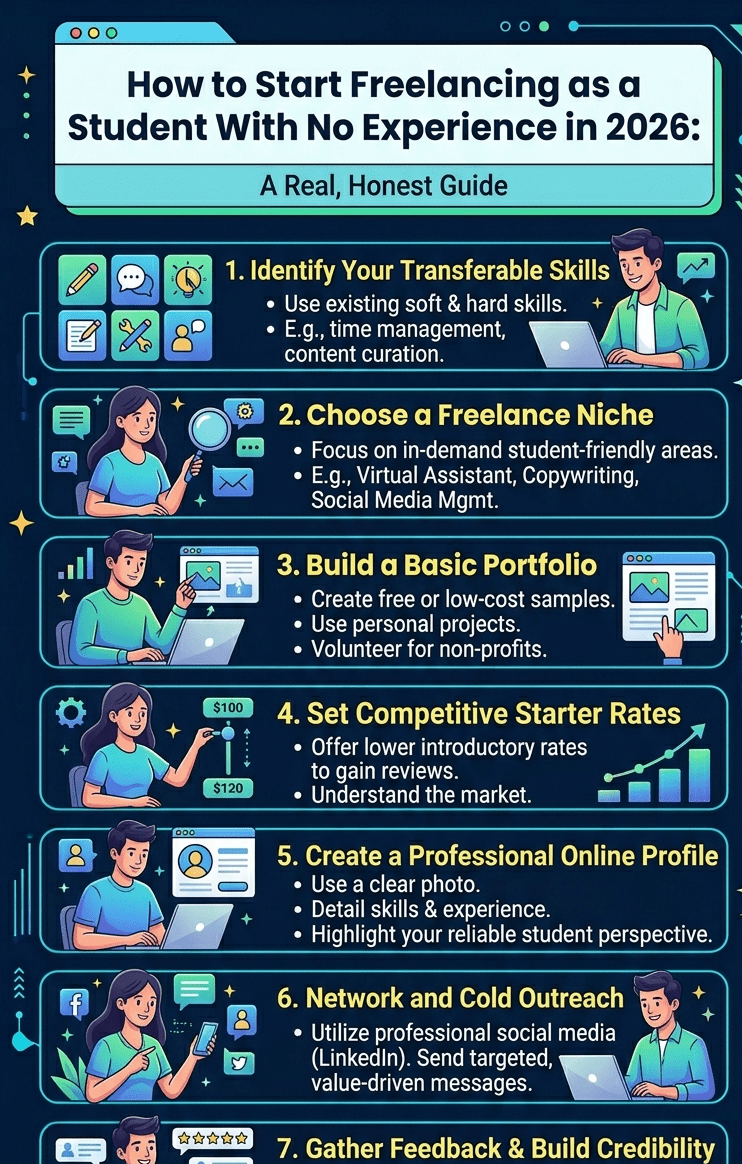
How to Start Freelancing as a Student With No Experience
in 2026: A Real, Honest Guide
Every student who has ever searched “how to earn money online”
has come across the word freelancing. It sounds exciting — work from
anywhere, be your own boss, earn in dollars or euros while sitting in
your hostel room or at your kitchen table. But then comes the question
that stops most students in their tracks: “How do I start when
I have absolutely no experience?”
This is the most honest guide you will find on this topic. We are
not going to give you a fantasy version of freelancing where you sign
up on Fiverr today and start making thousands of dollars tomorrow.
Instead, we are going to walk you through the real process — the
challenges, the strategies, the timelines, and the practical steps
that actually work for students who are starting completely from
scratch.
By the end of this article, you will have a clear roadmap to
go from zero experience to landing your very first paid freelancing
project. And if you follow through with patience and consistency,
freelancing can genuinely become one of the best financial decisions
you make as a student.
What is Freelancing and Why is it Perfect for Students?
Freelancing simply means offering your skills or services to
clients on a project basis instead of working as a permanent employee
for one company. As a freelancer, you can work with multiple clients,
set your own schedule, and work from anywhere with an internet
connection.
For students, this model is almost perfect. Your schedule already
changes every semester. You have free hours between classes. You have
long holidays. And more importantly, you have something that most
working professionals do not have — time and energy to learn new
skills rapidly. Freelancing allows you to monetize those skills at
your own pace without interfering with your academic responsibilities
if managed properly.
In 2026, the global freelancing market is worth hundreds of
billions of dollars. Millions of businesses — from tiny startups to
large corporations — hire freelancers regularly because it is often
more cost-effective and flexible than hiring full-time employees.
This means opportunities exist at every skill level, even for
complete beginners.
The Truth About Starting Freelancing With No Experience
Here is something nobody tells beginners: every single successful
freelancer you see today started with zero experience and zero
clients. The difference between those who succeeded and those who
gave up is not talent — it is strategy and persistence.
The challenge with having no experience is not that clients will
never hire you. The challenge is that you need to give them a reason
to trust you before they have seen your work. And the way you solve
that problem is by creating your own proof — through practice
projects, sample work, and personal projects that demonstrate your
skills even before a client pays you for them.
Think of it this way. A new restaurant does not open its doors
and expect customers to come in based on trust alone. They offer
tasting sessions, share photos of their food, and build a reputation
slowly. As a new freelancer, your portfolio is your tasting menu.
Your goal in the first few months is not to maximize earnings — it
is to build enough credibility to attract your first few paying
clients.
Step-by-Step Guide: How to Start Freelancing as a Student
Step 1: Choose a Freelancing Skill That Matches Your Strengths
Before you create any profile or send any proposals, you need to
decide what service you are going to offer. This is the most
important decision you will make as a new freelancer, because trying
to offer everything leads to offering nothing well.
The best approach is to start with something that connects to
either your existing knowledge or a genuine interest you have. If
you are studying business, digital marketing or content writing might
be a natural fit. If you enjoy computers, web development or graphic
design could be great starting points. If you are a strong writer,
copywriting or academic writing services could work well.
Here is an important tip — choose a skill with enough market
demand. There is no point in becoming very good at something that
nobody is willing to pay for. The skills listed below have strong,
consistent demand on freelancing platforms in 2026:
- Content Writing and Blogging —
High demand, beginner-friendly, good long-term growth - Graphic Design —
Creative, visual, great for portfolio building - Social Media Management —
Many small businesses need this desperately - Video Editing —
Exploding demand due to content creation boom - Web Development —
High paying, longer learning curve but very rewarding - SEO Services —
Strong demand, measurable results clients love - Data Entry and Virtual Assistance —
Easy to start, lower pay but great for building reviews - Translation Services —
If you know two languages well, this is immediately monetizable - AI Prompt Writing and AI Content Editing —
Brand new field with rapidly growing demand - Voiceover and Podcast Editing —
Niche but profitable for students with good audio setups
Step 2: Spend Time Actually Learning the Skill
Once you have chosen your skill, resist the temptation to jump
straight onto freelancing platforms. Spend at least 4 to 8 weeks
actively learning and practicing first. The quality of your early
work will determine whether clients leave you positive reviews or
negative ones, and those first reviews can make or break your
freelancing career.
Use these resources to learn:
- YouTube — Free, detailed tutorials on almost
every skill imaginable - Coursera and edX —
University-level courses, many available for free to audit - Google Digital Garage —
Free courses with certificates in digital marketing and more - HubSpot Academy —
Excellent free certifications in marketing and content - Udemy —
Affordable paid courses with lifetime access - FreeCodeCamp —
Free, comprehensive programming curriculum - Canva Design School —
Free design courses for beginner graphic designers
Practice every day. Build things. Write sample articles.
Design mock logos. Edit practice videos. The more you create during
this learning phase, the stronger your portfolio will be when you
start applying for projects.
Step 3: Build a Basic Portfolio (Even Without Clients)
This is the step where most beginners get stuck. They think
they cannot build a portfolio without clients, and they cannot get
clients without a portfolio. But this is a false dilemma. You can
absolutely build a strong portfolio before you have a single paying
client — it just requires some creativity.
Here is how to build portfolio pieces without clients:
- Create sample work:
Write 3 to 5 sample blog articles on topics in your niche.
Design logos for imaginary companies. Build a demo website.
Edit a sample video using royalty-free footage. - Do free work for real organizations:
Offer your services for free to a local NGO, a school,
a friend’s small business, or a community group.
Real projects look much better in a portfolio than
made-up ones, even if you were not paid. - Work on personal projects:
Start a blog, a YouTube channel, or an Instagram page related
to your skill. These are real projects that demonstrate
your ability and your initiative. - Participate in open challenges:
Many design and marketing communities run regular challenges
or competitions where you can submit work and get feedback.
Once you have 3 to 5 solid portfolio pieces, create a simple
portfolio page. You can use free tools like Google Sites,
Carrd.co, or even a well-organized PDF to showcase your work
professionally. Later, as you earn money, you can invest in
a proper personal website.
Step 4: Create Profiles on Freelancing Platforms
Now you are ready to create your profiles on freelancing
platforms. The major platforms where students can find work
include:
| Platform | Best For | Difficulty for Beginners | Payment Method |
|---|---|---|---|
| Fiverr | All skills, especially creative services | Easy to start | PayPal, Bank Transfer, Payoneer |
| Upwork | Professional services, long-term projects | Moderate | PayPal, Wire Transfer, Payoneer |
| Freelancer.com | Wide range of skills and project types | Easy to Moderate | PayPal, Skrill, Wire Transfer |
| PeoplePerHour | European clients, creative work | Moderate | PayPal, Payoneer |
| Toptal | Expert-level developers and designers | Very Hard (not for beginners) | Wire Transfer |
| Professional networking and direct clients | Moderate | Direct invoice | |
| 99designs | Graphic designers specifically | Moderate | PayPal, Wire Transfer |
For most student beginners, Fiverr is the best
starting point because it is easier to set up,
buyers come to you, and there is no competitive bidding
process. Upwork is excellent once you have
some reviews and want access to higher-paying projects.
When creating your profile, be completely honest. Do not
lie about your experience. Instead, focus on what you are
genuinely good at, what value you bring to clients, and
what your commitment to quality looks like. A transparent,
well-written profile from a beginner will always perform
better than an exaggerated one that sets false
expectations.
Step 5: Write Proposals That Actually Get Responses
On platforms like Upwork and Freelancer, you need to send
proposals to job postings. Most beginners make the mistake
of sending generic, copy-pasted proposals that start with
“I am a skilled professional with years of experience…”
These get ignored immediately.
A good proposal does three things:
- It shows the client that you have actually read and
understood their specific project requirements - It explains exactly how you plan to help them
solve their problem - It gives them a reason to trust you — through
portfolio samples, a relevant example, or a
specific insight about their project
Keep your proposals short — 150 to 250 words is usually
ideal. Do not write an essay. Clients receive dozens of
proposals and spend only a few seconds on each. Get to
the point quickly, show that you understand their needs,
and end with a clear next step like “I would love to
discuss this further — are you available for a quick
chat this week?”
Step 6: Price Yourself Smartly as a Beginner
Pricing is one of the trickiest parts of starting out.
Price too high and you will not get hired. Price too low
and you will work yourself to exhaustion for barely
any money — and also signal low quality to potential
clients.
As a beginner, your initial goal is to get your first
3 to 5 reviews and testimonials. This means you can afford
to price slightly below the market rate at the start —
but not so low that your work seems worthless. Research
what experienced freelancers in your skill charge,
and price yourself at roughly 40 to 60 percent of
that rate initially. As your reviews and portfolio
grow, raise your rates gradually and confidently.
Step 7: Deliver Excellent Work and Ask for Reviews
When you land that first project, treat it like the
most important project of your life. Communicate clearly
with the client. Deliver on time or even a little early.
Go slightly beyond what was agreed to show genuine effort.
And after delivery, politely ask the client to leave you
a review if they are happy with the work.
Reviews and ratings are the currency of freelancing
platforms. A freelancer with 10 five-star reviews will
always get more opportunities than someone with better
skills but no reviews. Your early goal is to build
that reputation, because it will compound over time
and make everything easier.
Common Mistakes New Student Freelancers Make
- Creating profiles on every platform at once:
Focus on one or two platforms and build your reputation there
before spreading yourself thin. - Quitting after the first rejection:
Rejection is normal, especially at the start.
Every successful freelancer has dozens of
rejection stories. Keep applying. - Not communicating enough with clients:
Regular, clear communication builds trust.
Update your client on progress even if they do not ask. - Taking on more work than they can handle:
It is tempting to say yes to everything when you are
starting out, but missing deadlines will destroy
your reputation faster than anything else. - Ignoring their studies for freelancing:
Your degree is still important. Balance is key.
Do not let freelancing become a reason to
neglect your academic responsibilities. - Not saving or tracking their income:
Even as a student, develop good financial habits.
Track what you earn, save a portion,
and keep records of your work and payments.
Realistic Income Expectations for Student Freelancers
Let us be completely honest about what you can expect
to earn at different stages of your freelancing journey.
These are realistic ranges based on general market
observations — your actual earnings will depend on
your skill, niche, effort, and consistency.
| Stage | Timeline | Expected Monthly Income | Main Goal |
|---|---|---|---|
| Complete Beginner | Month 1 to 3 | $0 to $100 | Learning, building portfolio |
| Early Stage | Month 3 to 6 | $100 to $400 | First clients, first reviews |
| Growing Freelancer | Month 6 to 12 | $400 to $1000 | Consistent clients, raising rates |
| Established Freelancer | Year 1 to 2 | $1000 to $3000+ | Long-term clients, higher value work |
Tips to Get Your First Client Faster
- Tell people in your life:
Let your friends, family, professors, and classmates
know what service you offer.
Your first client is often someone you already know. - Be active in online communities:
Facebook Groups, Reddit communities,
LinkedIn groups, and Discord servers in your
niche are full of people looking for help.
Add value to conversations and
mention your services naturally. - Optimize your Fiverr gig SEO:
Use relevant keywords in your gig title and description
so clients can find you when they search. - Offer a free mini-service or audit:
For example, offer a free 5-minute website audit
or a free sample paragraph of writing.
This low-risk offer helps nervous
clients say yes more easily. - Respond to client messages quickly:
Fast response time signals professionalism
and increases your chances of being hired.
Frequently Asked Questions (FAQs)
Q1: Can a student with no degree start freelancing?
Absolutely. Freelancing is one of the few fields
where your skills and results matter far more than your
formal qualifications. Many successful freelancers never
completed a university degree. What matters is whether
you can deliver quality work to clients consistently.
Q2: How many hours per week should a student
dedicate to freelancing?
Starting with 10 to 15 hours per week is a healthy
balance for most students. This gives you enough time
to take on small projects while still keeping up
with your studies. As you get faster and more efficient,
you can increase your hours during holidays
or lighter academic periods.
Q3: Is Fiverr really good for complete beginners?
Yes, Fiverr is generally the most beginner-friendly
major freelancing platform because buyers come
to you rather than you having to compete
in a bidding process. However, it can take
time to get your first order because new gigs
take time to get visibility. Be patient,
optimize your gig well, and promote
it through your social media as well.
Q4: Do I need to register a business to
start freelancing as a student?
In most countries, students can start freelancing
as individuals without registering a formal business.
However, it is always good to understand the
tax rules in your country. In many places,
if your freelancing income is below a certain threshold,
you do not need to pay taxes on it. As your income
grows, consult with a local accountant or do
research on self-employment tax rules in your region.
Q5: What if my English is not very strong —
can I still freelance?
Yes. Many successful freelancers work with
clients in their own language or in specific
regional markets. Additionally, skills like
graphic design, video editing,
and programming do not require strong
English communication skills to deliver
quality work. That said, improving your
written English communication will open
up significantly more opportunities over time.
Conclusion: Start Small, Think Big,
Stay Consistent
Freelancing as a student with no experience
is completely possible. Thousands of students
around the world are doing it right now.
The path is not always easy —
there will be slow months, difficult clients,
rejected proposals, and moments of self-doubt.
But every challenge you face in this journey
will teach you something valuable about
business, communication, and yourself.
The students who succeed in freelancing
are not the most talented ones.
They are the ones who start,
who keep going when things get tough,
and who never stop improving their skills
and their understanding of what clients need.
You have everything you need to begin.
Pick your skill today.
Start learning today.
Build your first portfolio piece today.
The only thing standing between you
and your first freelancing income
is the decision to actually start.
Explore More Helpful Articles on Edu2Work:
- Best High Income Skills for Students in 2026
- Top Remote Jobs for Students You Can Do From Home
- How to Write a Resume With No Work Experience
- Best Free Online Courses With Certificates in 2026
- How to Manage Time as a Student and Still Earn Money


