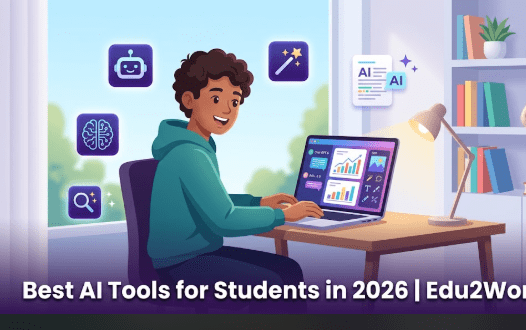
Best AI Tools for Students in 2026
to Study Smarter, Save Time,
and Get Better Results
Something remarkable has happened
in education over the last few years.
The same artificial intelligence technology
that was once only available
to large corporations and
research institutions is now
sitting right in the palm
of every student’s hand —
often completely free of charge.
And the students who understand
how to use these tools wisely
are gaining a significant advantage
over those who do not even
know they exist.
But here is something important
to understand right from the start.
This article is not going
to encourage you to use
AI tools to cheat,
copy assignments, or bypass
the genuine learning process.
That approach will hurt you
in the long run —
both academically and professionally.
Instead, this guide focuses on
how to use AI tools
the smart way —
as powerful assistants that
help you understand things faster,
organize your work better,
research more efficiently,
and produce higher quality output
through your own genuine effort
and thinking.
The students who thrive in 2026
and beyond will not be
those who avoided AI out of fear,
or those who used it
as a shortcut to avoid thinking.
They will be the ones
who learned to work alongside AI
as a powerful tool —
the same way previous generations
learned to use calculators,
the internet, and search engines.
This guide will show you exactly
how to do that.
Why Every Student Needs
to Understand AI Tools in 2026
The job market in 2026
already expects many professionals
to be comfortable working
with AI tools in their daily workflow.
Marketing professionals use AI
for content planning and analytics.
Developers use AI coding assistants.
Designers use AI for ideation
and rapid prototyping.
Business analysts use AI
for data interpretation.
Writers use AI for research
and editing assistance.
This means that as a student,
getting familiar with AI tools now —
understanding their capabilities,
their limitations,
and how to get
the best results from them —
is directly building a skill
that employers will value
when you graduate.
You are not just studying smarter.
You are also building
a genuinely marketable
professional skill for your future career.
Additionally, the practical benefits
for your student life are enormous.
AI tools can help you
understand complex concepts faster,
organize overwhelming amounts
of information, overcome
writer’s block, prepare
for exams more effectively,
manage your time better,
and produce higher quality work
in less time — leaving you
more energy for the other
important parts of student life.
How to Use AI Tools
the Right Way as a Student
Before we get into
the specific tools,
let us establish some
clear principles for
using AI ethically and effectively:
- Use AI to understand,
not to replace your thinking:
Ask AI to explain a concept
in simple terms,
then process that explanation
yourself and form your own understanding. - Always verify AI-generated information:
AI tools can be wrong.
They can generate plausible-sounding
but factually incorrect information.
Always cross-check important facts
with reliable primary sources. - Use AI as an editor,
not a writer:
Write your own first draft,
then use AI to help
improve clarity, grammar,
and structure —
rather than having AI
write everything from scratch. - Follow your institution’s
AI policy:
Different universities have
different rules about
AI use in assignments.
Know your institution’s policy
and respect it completely. - Think of AI as a tutor,
not a cheat sheet:
The best use of AI in studying
is asking it to explain things,
quiz you, give feedback,
and help you think —
not to do your work for you.
Best AI Tools for Students in 2026
1. ChatGPT (OpenAI)
Best For:
Explaining concepts,
brainstorming, writing assistance,
practice quizzes,
research starting points
Cost:
Free (GPT-3.5) |
ChatGPT Plus $20/month (GPT-4o)
Available On:
Web browser,
iOS and Android app
ChatGPT is probably the most
well-known AI tool in the world
right now, and for good reason.
It is extraordinarily versatile
and genuinely useful
for students across
almost every academic discipline.
But most students only use
a tiny fraction of
what ChatGPT is capable of —
and usually in ways that
do not serve their
learning well.
Here are genuinely smart ways
students can use ChatGPT:
- Ask it to explain a difficult
concept from your textbook
in simple, everyday language —
“Explain quantum entanglement
as if I am 15 years old” - Ask it to create
a practice quiz on a topic
you are studying —
“Give me 10 multiple choice
questions on the causes
of World War One” - Ask it to give you
feedback on your essay structure —
paste your outline and
ask what is missing
or unclear - Use it to brainstorm
angles and arguments
before writing an essay —
then choose the ones
that resonate with
your own thinking - Ask it to summarize
a long research paper
and identify the main arguments —
then read the original
to verify and deepen understanding - Practice speaking a new language
by having conversations
with ChatGPT in that language
The free version of ChatGPT
is genuinely powerful
for most student needs.
ChatGPT Plus (paid)
gives you access to
more advanced features
including image analysis,
document uploads,
and more sophisticated reasoning —
useful but not essential
for most undergraduate students.
2. Google Gemini
Best For:
Research assistance,
real-time information,
image analysis,
Google Workspace integration
Cost:
Free |
Gemini Advanced available
with Google One subscription
Available On:
Web browser,
Android (built-in on many devices),
iOS app
Google Gemini is Google’s
flagship AI assistant
and it has several advantages
over other AI tools
that make it particularly
valuable for students.
Most importantly,
Gemini has access to
real-time information from
the internet —
meaning it can provide
current information
that ChatGPT’s offline
training data might miss.
For students, Gemini is
especially useful for
research tasks where
current information matters.
It also integrates seamlessly
with Google Docs,
Google Slides, Gmail,
and other Google Workspace tools
that many students use daily.
You can ask Gemini
to help you draft
an email, improve
a Google Doc,
or create a presentation outline
directly within those applications.
Gemini also has impressive
multimodal capabilities —
you can show it an image
of a complex diagram
or a math problem
written on paper
and ask it to explain
or solve what it sees.
This is a remarkable
study tool for subjects
like mathematics, physics,
and chemistry where
visual problem-solving
is important.
3. Grammarly
Best For:
Writing improvement,
grammar checking,
tone adjustment,
plagiarism detection
Cost:
Free (basic) |
Premium from $12/month |
Free for students
through many universities
Available On:
Browser extension,
desktop app,
Microsoft Word plugin,
Google Docs integration
Grammarly has been helping
students write better
for years, but in 2026
it has evolved into
a genuinely powerful
AI writing assistant
that goes far beyond
simple spell-checking.
The AI-powered suggestions
now include tone adjustments,
clarity improvements,
engagement scoring,
and full sentence rewrites
that maintain your meaning
while improving your expression.
For students whose first language
is not English,
Grammarly is an absolute
game-changer.
It helps you communicate
your ideas more clearly
and professionally in English
without changing your
voice or arguments —
just improving how
they are expressed.
Check if your university
offers Grammarly Premium
for free —
many institutions
have institutional licenses
that students can access
at no cost.
4. Notion AI
Best For:
Note organization,
study planning,
project management,
summarizing notes,
generating study guides
Cost:
Free (basic Notion) |
Notion AI add-on $10/month |
Free plan very generous
Available On:
Web browser,
desktop app (Windows and Mac),
iOS and Android
Notion has become
one of the most popular
productivity tools
among students worldwide,
and the addition of
Notion AI has made it
even more powerful.
Notion is essentially
a digital workspace
where you can take notes,
manage projects,
create databases,
plan your schedule,
and organize every aspect
of your student life
in one place.
Notion AI adds
a layer of intelligence
to this workspace.
You can ask it to
summarize your lecture notes
into key points,
generate a study schedule
based on your upcoming exams,
create a structured outline
for your essay from
bullet points you have jotted down,
or translate your notes
into a different format
for easier review.
Many students have replaced
a combination of
Google Docs, Google Calendar,
Trello, and separate
note-taking apps
with just Notion alone —
simplifying their
entire study system
into one clean,
searchable workspace.
The free plan is
very generous and
more than sufficient
for most students.
5. Otter.ai
Best For:
Recording and transcribing
lectures and meetings,
automatic note-taking,
searchable transcripts
Cost:
Free (300 minutes/month) |
Pro from $16.99/month
Available On:
Web browser,
iOS and Android app,
Zoom integration
If you have ever sat
in a fast-paced lecture
trying desperately to
write notes while
simultaneously trying
to listen and understand —
Otter.ai will feel
like a miracle.
This AI tool records
audio and converts it
to accurate, searchable
text transcripts in real time.
You can focus entirely
on listening and understanding
during the lecture,
knowing that Otter
is capturing every word.
After the lecture,
Otter provides you
with a full transcript
that you can search,
highlight, and annotate.
It automatically identifies
different speakers,
which is particularly
useful in seminars
and discussion classes.
The free plan provides
300 minutes of transcription
per month —
more than enough
for most students
to cover several
lectures per week.
Always check with your professor
before recording lectures —
some institutions have
policies about recording
academic sessions
and you should always
get permission before using
this tool in a class setting.
6. Wolfram Alpha
Best For:
Mathematics, science,
engineering calculations,
step-by-step problem solving,
data analysis
Cost:
Free (basic) |
Pro from $7.25/month
Available On:
Web browser,
iOS and Android app
For students in STEM fields —
Science, Technology,
Engineering, and Mathematics —
Wolfram Alpha is
one of the most powerful
study tools available.
Unlike a simple calculator,
Wolfram Alpha understands
natural language queries
and can solve incredibly
complex mathematical problems
while showing you
every step of the solution
process in detail.
You can ask Wolfram Alpha
to solve calculus problems,
plot graphs,
compute statistics,
balance chemical equations,
analyze data sets,
solve physics problems,
and much more.
The step-by-step solutions
are particularly valuable
because they help you
understand the process —
not just get the answer.
This is a genuine
learning tool,
not just an answer machine,
when used correctly.
7. Quizlet AI
Best For:
Creating flashcards,
memorization,
exam preparation,
vocabulary learning
Cost:
Free (basic) |
Quizlet Plus from $7.99/month
Available On:
Web browser,
iOS and Android app
Quizlet has been
a student favorite
for years, but its AI features
in 2026 have made it
significantly more powerful.
The AI can now generate
a complete set of
flashcards automatically
from a block of text
you paste in —
saving enormous amounts
of time creating study materials.
You can paste in
your lecture notes or
a textbook chapter
and Quizlet will
identify and extract
the key terms and
concepts into flashcard format.
Quizlet’s study modes
use spaced repetition —
a scientifically proven
learning technique that
shows you information
at increasing intervals
to maximize long-term retention.
This is one of
the most effective methods
for memorizing large amounts
of information for exams,
and Quizlet’s AI
automates the scheduling
of your review sessions
based on your
actual performance.
8. Canva AI (Magic Studio)
Best For:
Creating presentations,
posters, infographics,
study materials,
social media content
Cost:
Free (very generous) |
Pro from $12.99/month
Available On:
Web browser,
iOS and Android app,
desktop app
Canva has become
the go-to design tool
for students who need
to create professional-looking
presentations, posters,
infographics, and visual content
without any graphic design experience.
The AI features in
Canva’s Magic Studio
take this even further —
you can now describe
a design you want
and AI will generate it,
transform a basic presentation
into a polished visual design
with one click,
or generate images
for your projects
using text prompts.
For students who regularly
need to create presentations
for class, research posters,
event flyers, or
portfolio materials —
Canva’s AI features
can cut your design time
by 60 to 70 percent
while actually improving
the quality of your output.
The free plan is
extremely generous
and covers the needs
of most students completely.
9. Perplexity AI
Best For:
Academic research,
fact-checked information
with sources,
literature review starting points
Cost:
Free |
Pro from $20/month
Available On:
Web browser,
iOS and Android app
Perplexity AI is one of
the most underrated study tools
for students in 2026
and arguably one of
the most valuable for
academic research specifically.
Unlike ChatGPT which can
sometimes generate incorrect
information without warning,
Perplexity provides answers
with direct citations
and source links —
meaning you can verify
every piece of information
it gives you and
trace it back
to the original source.
This makes Perplexity
far more suitable
for academic research
than most other AI tools.
You can ask it
complex research questions,
get well-structured answers
with proper source attribution,
and then follow the links
to read the original
papers, articles,
or websites for
deeper understanding
and proper academic citation.
10. Elicit
Best For:
Academic literature search,
research paper summarization,
finding relevant studies
Cost:
Free (limited) |
Plus from $10/month
Available On:
Web browser only
Elicit is an AI research
assistant specifically designed
for academic work.
It searches through
millions of academic papers,
identifies the most relevant ones
for your research question,
and provides clear summaries
of each paper’s key findings,
methodology, and conclusions.
For students working on
literature reviews,
research papers,
or dissertations —
Elicit can save
enormous amounts of time
that would otherwise
be spent manually
searching through databases
and reading paper abstracts.
The tool is particularly
impressive because it
understands nuanced research questions
and can identify relevant studies
even when they use
different terminology
than your query.
This kind of semantic search
is something traditional
academic search engines
like Google Scholar
cannot do as effectively.
11. Microsoft Copilot
Best For:
Microsoft Office integration,
Word documents,
Excel analysis,
PowerPoint presentations,
Teams meetings
Cost:
Free (built into Windows 11
and Microsoft Edge) |
Microsoft 365 Copilot
for advanced features
Available On:
Windows, web browser,
iOS and Android
If you use Microsoft Office
for your studies —
which most students do —
Microsoft Copilot is
an AI assistant that
works directly inside
Word, Excel, PowerPoint,
and Teams.
It can help you
draft and edit documents
in Word, analyze data
and create charts in Excel,
design presentation slides
in PowerPoint,
and summarize meeting notes in Teams.
The free version available
through Microsoft Edge
and Windows 11
is already quite capable
for most student needs.
If your university
provides Microsoft 365
for free (many do),
check whether Copilot
is included in your
institutional license —
you may already have
access to the full version
without knowing it.
AI Tools Comparison Table
| Tool | Best Use Case | Free Plan | Difficulty | Must Have? |
|---|---|---|---|---|
| ChatGPT | Explaining concepts, brainstorming | ✅ Yes | Very Easy | 🔥 Yes |
| Google Gemini | Real-time research, Google integration | ✅ Yes | Very Easy | 🔥 Yes |
| Grammarly | Writing and grammar improvement | ✅ Yes | Very Easy | 🔥 Yes |
| Notion AI | Note organization, study planning | ✅ Yes | Easy | ✅ Recommended |
| Otter.ai | Lecture transcription | ✅ Yes (300 min) | Very Easy | ✅ Recommended |
| Wolfram Alpha | STEM problem solving | ✅ Yes (basic) | Easy | ✅ For STEM students |
| Quizlet AI | Flashcards and memorization | ✅ Yes | Very Easy | ✅ Recommended |
| Canva AI | Presentations and design | ✅ Yes | Very Easy | ✅ Recommended |
| Perplexity AI | Research with citations | ✅ Yes | Easy | 🔥 Yes |
| Elicit | Academic literature search | ✅ Limited | Easy | ✅ For researchers |
| Microsoft Copilot | Office documents and presentations | ✅ Yes | Very Easy | ✅ Recommended |
Best AI Tool Combinations
for Different Types of Students
| Student Type | Recommended AI Stack | Main Benefit |
|---|---|---|
| Arts and Humanities Student | ChatGPT + Grammarly + Perplexity + Canva AI |
Better writing, faster research, professional presentations |
| STEM Student | Wolfram Alpha + ChatGPT + Notion AI + Quizlet |
Problem solving, concept understanding, memorization |
| Business Student | ChatGPT + Grammarly + Notion AI + Microsoft Copilot |
Report writing, data analysis, presentations |
| Research Student | Elicit + Perplexity + Notion AI + Grammarly |
Literature review, organized notes, better writing |
| Language Student | ChatGPT + Grammarly + Quizlet + Otter.ai |
Practice conversations, vocabulary building, listening |
| Creative Student | Canva AI + ChatGPT + Grammarly + Notion AI |
Design, writing, brainstorming, organization |
Smart Study Workflow Using
AI Tools — Step by Step
Before a Lecture
- Use ChatGPT or Gemini
to get a quick overview
of the topic that will be covered —
“Give me a brief introduction
to supply and demand economics” —
so you are not hearing
concepts for the first time
during the lecture - Use Notion AI
to set up a note template
for the lecture with
key questions you want answered
During a Lecture
- Use Otter.ai
(with permission)
to record and transcribe
the lecture automatically - Focus fully on
listening and understanding
rather than frantic note-taking
After a Lecture
- Use Notion AI
to organize and summarize
your notes into key points - Use ChatGPT
to explain anything
you did not fully understand - Use Quizlet AI
to generate flashcards
from the lecture material
When Writing an Assignment
- Use Perplexity or Elicit
to find relevant sources
and research with citations - Use ChatGPT
to brainstorm arguments
and structure your outline - Write your own draft
using your own words and thinking - Use Grammarly
to polish grammar,
clarity, and tone
When Preparing for Exams
- Use Quizlet AI
for spaced repetition flashcard practice - Use ChatGPT
to quiz you with
practice questions:
“Quiz me on the French Revolution
using 15 questions” - Use Wolfram Alpha
for mathematics and science
practice problems with solutions
Common Mistakes Students Make
With AI Tools
- Using AI to write
entire assignments:
This is academic dishonesty
in most institutions
and also deprives you
of the genuine learning
the assignment was designed to provide.
The skills you fail to build now
will hurt you in exams
and in your career. - Trusting AI information
without verification:
AI tools can and do
make factual errors —
sometimes very confidently.
Always verify important facts
from primary sources
before including them
in academic work. - Using too many tools
at once:
Start with two or three
core tools and master them
before adding more.
Tool overload creates
confusion and wastes time. - Becoming dependent on AI
for basic thinking:
Your own critical thinking
is your most valuable skill.
Use AI to support it —
not replace it. - Ignoring AI tool privacy settings:
Be careful about what
personal information you share
with AI tools,
especially any sensitive
academic or personal data.
Tips to Get Maximum Value
From AI Study Tools
- Be specific in your prompts:
The more specific and detailed
your question or instruction,
the better the response.
“Explain photosynthesis”
gives a generic answer.
“Explain the light-dependent
reactions of photosynthesis
in simple terms for
a first-year biology student
who understands basic chemistry”
gives a much more useful one. - Ask AI to check your thinking:
Write your own answer first,
then ask the AI
“Here is my answer —
what have I missed
or gotten wrong?”
This builds real understanding. - Use AI for feedback loops:
Ask ChatGPT to play
the role of your professor
and give critical feedback
on your essay draft —
it can be surprisingly insightful. - Create your own AI study system:
Combine tools deliberately
for your specific needs
rather than using them randomly.
A consistent system
produces consistent results. - Experiment and explore:
The best way to discover
how AI tools can help you
is to try different approaches
and see what works
for your learning style.
Frequently Asked Questions (FAQs)
Q1: Is it cheating to use
AI tools for studying?
Using AI tools to help you
understand concepts, organize notes,
practice for exams,
and improve your writing
is generally completely acceptable
and is actually encouraged
by many educators.
However, using AI to
write assignments and
submitting that work as your own
is academic dishonesty
in most institutions.
The line is between
using AI as a learning tool
versus using it to
bypass the learning process entirely.
Always check your university’s
specific AI use policy.
Q2: Which single AI tool
should a student start with?
Start with ChatGPT
on its free plan.
It is the most versatile,
easiest to use,
and immediately useful
across virtually every
academic subject and task.
Once you are comfortable with it,
add Grammarly for writing
and Perplexity for research.
Those three tools together
cover the vast majority
of student needs.
Q3: Are these AI tools
safe for students to use?
The tools listed in this guide
are from established,
reputable companies
and are generally safe to use.
However, be thoughtful about
what information you share.
Avoid entering sensitive
personal information,
confidential academic data,
or information that your
institution considers private.
Read each tool’s
privacy policy before use.
Q4: Can AI tools really
help improve grades?
When used correctly —
as learning accelerators
rather than shortcuts —
yes, AI tools can
genuinely help improve grades.
Students who use AI
to understand concepts more deeply,
practice more effectively,
write more clearly,
and organize their studying more efficiently
consistently report better
academic performance.
The key word is “correctly” —
using AI to actually learn more,
not to avoid learning.
Q5: Do I need to pay
for AI tools to get real benefits?
No. The free versions of
ChatGPT, Gemini, Grammarly,
Notion, Otter.ai, Quizlet,
Canva, and Perplexity
are all genuinely useful
for students without
any payment required.
Paid plans offer additional features,
but for most undergraduate
and graduate students,
the free tiers provide
more than enough value
to meaningfully improve
your study experience.
Conclusion:
AI Tools Are Your
Study Superpower —
Use Them Wisely
We are living through
one of the most exciting
moments in the history
of education.
For the first time ever,
every student —
regardless of whether
they attend a top university
or a small local college,
regardless of their
financial background,
regardless of where
in the world they are —
has access to AI-powered
learning tools that were
simply unimaginable
just a few years ago.
These tools will not
do your thinking for you.
They will not replace
the hard work of
genuine learning,
consistent effort,
and developing your
own critical mind.
But they will make
your studying more efficient,
your understanding deeper,
your output more polished,
and your time more productive —
if you use them
with intention and wisdom.
Start with one or two
tools from this list today.
Experiment with them
for your next study session.
Notice what helps
and what does not.
Build your personal
AI-powered study system
over the coming weeks.
And remember —
the goal is always
to become a more capable,
more knowledgeable,
and more confident learner.
AI is just one
very powerful tool
to help you get there.
More Helpful Articles on Edu2Work:
- Best High Income Skills for Students in 2026
- How to Start Freelancing as a Student
With No Experience - Top Remote Jobs for Students in 2026
- Best Free Online Courses
With Certificates in 2026 - How to Write a Resume
With No Work Experience