
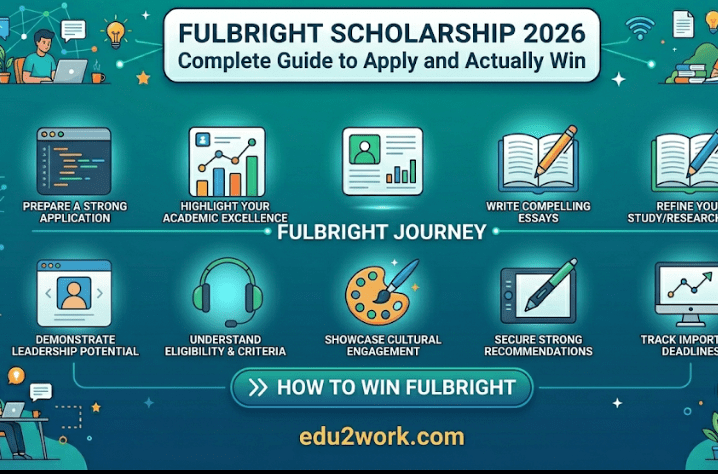
Fulbright Scholarship 2026: Complete Guide to Apply and Actually Win
📂 Category: Scholarships |
⏱️ Read Time: ~11 Minutes |
✍️ Editorial Team
📣 Share This & Help a Student Change Their Life:
🐦 Twitter / X |
✈️ Telegram |
There are hundreds of scholarships in the world. But only a handful carry
the kind of weight that genuinely transforms careers, opens government
doors, and places you inside one of the most powerful alumni networks on
the planet. The Fulbright Scholarship is one of them.
Since 1946, the Fulbright Program has funded over 400,000 students,
scholars, and professionals from more than 160 countries to study,
teach, and research in the United States — and American citizens to
do the same abroad. Its alumni include Nobel Prize winners, heads of
state, Pulitzer Prize recipients, and leaders across virtually every
professional field imaginable.
But here’s what nobody says clearly enough: the Fulbright is
not just for perfect-GPA candidates from elite universities.
It is for people with genuine stories, authentic goals, and the
communication skills to express both compellingly. Students from
modest backgrounds, small universities, and developing countries
win Fulbright scholarships every single year — because the selection
committee is not just looking at your transcript. They are looking
at you.
This guide will tell you everything — what the scholarship actually
covers, who qualifies, what the application requires, and most
importantly, what separates winners from the rest of the applicant pool.
What Is the Fulbright Scholarship — And What Does It Cover?
The Fulbright Program is funded by the U.S. Department of State and
administered through the Bureau of Educational and Cultural Affairs.
It operates in over 160 countries and is considered one of the most
prestigious academic exchange programs in existence.
For international students applying to study in the United States,
the Fulbright Foreign Student Program typically covers:
- ✅ Full tuition fees at a U.S. university
- ✅ Monthly living stipend to cover accommodation and food
- ✅ Round-trip airfare to and from the United States
- ✅ Health insurance for the duration of study
- ✅ Book and study materials allowance
- ✅ English language training if required before arrival
- ✅ Enrichment activities — cultural trips, conferences, networking events
In short — if you win a Fulbright, your financial barriers to studying
in the United States are essentially eliminated. The program is designed
to make sure money is never the reason a brilliant, committed person
cannot access world-class education.
Who Can Apply — Eligibility Criteria
Eligibility varies slightly by country — each country has its own
Fulbright commission or U.S. Embassy program that manages the local
selection process. However, the core requirements for the
Fulbright Foreign Student Program are:
| Requirement | Details |
|---|---|
| Nationality | Citizen of a Fulbright-eligible country (160+ nations) |
| Residence | Must be residing in your home country at time of application |
| Education Level | Bachelor’s degree completed (for Master’s/PhD applicants) |
| English Proficiency | Strong English required — TOEFL/IELTS often needed |
| Academic Merit | Strong academic record (not necessarily perfect) |
| Leadership Potential | Demonstrated ability to lead and contribute to community |
| Return Commitment | Commitment to return home after completing the program |
| Age | Varies by country — most accept applicants 22–35 |
Important: U.S. permanent residents and dual citizens
with U.S. citizenship are generally not eligible for the Foreign Student
Program. Check your country’s specific Fulbright commission website for
exact local requirements.
Read more: Full List of Fulbright-Eligible Countries and Local Deadlines
What Fields of Study Does Fulbright Cover?
One of the most common misconceptions about Fulbright is that it only
funds science, technology, or policy research. This is completely false.
Fulbright funds study and research across virtually every academic
discipline, including:
- 🎓 Arts, Literature & Creative Writing
- 🎓 Business & Management
- 🎓 Education & Teaching
- 🎓 Engineering & Technology
- 🎓 Environmental Science & Climate Studies
- 🎓 Health Sciences & Public Health
- 🎓 Law & Governance
- 🎓 Journalism & Media Studies
- 🎓 Political Science & International Relations
- 🎓 Psychology & Social Work
- 🎓 STEM (Science, Technology, Engineering, Maths)
- 🎓 Social Sciences & Economics
What matters is not your field — it is the quality and clarity of
your goals within that field, and the strength of your argument for
why the United States is the right place to pursue them.
The Fulbright Application: What You Actually Need to Submit
The Fulbright application is comprehensive. It takes serious time and
genuine thought to complete well. Here is exactly what most country
applications require:
1. Online Application Form
Completed through your country’s Fulbright portal or the U.S. Embassy
website. Includes personal information, educational background, work
history, and program preferences.
2. Study Objective / Personal Statement
This is the most important document in your entire application.
More on this below — we are dedicating a full section to it
because it is where most applications succeed or fail.
3. Personal Statement (Biographical Essay)
A separate essay about who you are — your background, your journey,
what shaped you, and what drives your professional and personal goals.
This is your opportunity to be human. Not just impressive — human.
4. Academic Transcripts
Official transcripts from all universities attended. Request these
from your institution at least 6 weeks before the application deadline.
5. Three Reference Letters
Typically two academic references and one professional reference.
These must speak to your intellectual ability, your leadership
qualities, and your potential for impact — not just say that
you are “a hardworking student.”
6. Language Score (TOEFL/IELTS)
Required for most non-native English speakers. Check your country’s
specific minimum score requirement. Prepare and sit the test at
least 3 months before the application deadline to allow time
for retakes if needed.
7. University Affiliation Letters (if applicable)
Some Fulbright programs require you to already have a letter of
affiliation or acceptance from a U.S. university. Others handle
university placement centrally. Check your country’s program
requirements specifically.
8. Curriculum Vitae (CV)
A detailed academic and professional CV. Include everything
relevant — research experience, publications, community leadership,
awards, teaching experience, and language skills.
The Study Objective Essay — This Is Where You Win or Lose
Let’s be completely direct about this. The Fulbright selection committee
reads thousands of applications from academically qualified candidates.
What separates winners from the rest is almost always the
Study Objective essay.
This essay answers three core questions:
- What do you want to study or research?
- Why do you need to study it in the United States specifically?
- How will you use this knowledge when you return home?
Every single sentence of your Study Objective should connect back
to at least one of these three questions. Anything that doesn’t
— cut it.
What a Weak Study Objective Looks Like
Most applicants write something like this:
“I want to study Public Health at an American university because
the United States has excellent universities with world-class facilities.
I am passionate about improving healthcare in my country and believe
this scholarship will help me achieve my goals.”
This tells the committee absolutely nothing specific. It could have
been written by any of the 10,000 other applicants. It shows passion
but zero substance.
What a Strong Study Objective Looks Like
A strong essay does this instead:
“In my district of [Name], a region of 400,000 people, there is one
functioning public hospital and a maternal mortality rate four times
the national average. In three years working as a community health
coordinator there, I have identified the core issue: not a lack of
medical facilities, but a lack of trained healthcare administrators
who can design, fund, and sustain rural health programs. My proposed
research at [Specific U.S. University] under Professor [Name], whose
work on community health systems in low-resource settings is directly
relevant to my region, will allow me to design a scalable health
administration training program that I intend to pilot in three
districts within two years of returning.”
Do you see the difference? This applicant has:
- ✅ Named a specific, real problem with real numbers
- ✅ Connected personal experience to academic goals
- ✅ Named a specific university and a specific professor
- ✅ Described a concrete plan for impact after returning
- ✅ Given the committee a reason to believe this scholarship will matter
That is the standard you are competing at. Start drafting your
essay with this level of specificity in mind.
How to Choose the Right U.S. University for Fulbright
Many applicants make the mistake of targeting only Harvard, MIT, or
Stanford — and while winning Fulbright scholars do attend these
institutions, most attend universities that are the best fit for their
specific research goals rather than the most famous.
When choosing your target university, ask these questions:
- Which professors are actively researching my exact topic?
- Does this university have the labs, data, or partnerships I specifically need?
- Has this university hosted Fulbright scholars before?
- Does the program have strong alumni in my target career path?
Research professors directly. Email them before applying — introduce
yourself, reference their specific research, and ask if they would
welcome a Fulbright applicant working with them. A professor’s
expressed interest significantly strengthens your application and
can sometimes lead to an affiliation letter.
Read more: How to Email a Professor for Research Opportunities — Templates Included
Your Reference Letters — The Hidden Make-or-Break Factor
Many Fulbright applications are undermined not by weak personal
statements, but by weak reference letters. Here’s how to get
strong ones:
- Choose carefully: Pick referees who know your
work deeply — not just your name. A professor who marked one
of your papers and vaguely remembers you is far less valuable
than one who supervised your thesis or research project. - Brief them properly: Send each referee your
full application draft, your CV, the Fulbright’s stated
selection criteria, and specific examples of work you did
together that you’d like them to reference. Make it as easy
as possible for them to write something powerful. - Be explicit: Tell your referees that Fulbright
is looking for leadership potential, cross-cultural adaptability,
academic excellence, and a clear commitment to contributing to
your home country. Give them the language. - Give ample time: Request letters at minimum
6–8 weeks before deadline. Follow up gently 2 weeks before
to confirm submission status.
Timeline: When to Start Your Fulbright Application
| Timeline | Action |
|---|---|
| 6–8 Months Before Deadline | Research your country’s Fulbright program and deadline |
| 6 Months Before | Identify target universities and contact professors |
| 5 Months Before | Begin drafting Study Objective and Personal Statement |
| 4–5 Months Before | Request reference letters and official transcripts |
| 4 Months Before | Sit TOEFL/IELTS exam if not already done |
| 3 Months Before | Complete draft application — get feedback from mentors |
| 2 Months Before | Revise all essays — at least 3 full drafts |
| 1 Month Before | Final review — check every document, confirm references submitted |
| Deadline Week | Submit — never wait until the final day |
After Submission: What to Expect
After submitting your application, the process typically works as follows:
- National screening: Your local Fulbright commission
or U.S. Embassy reviews all applications and creates a shortlist. - Interview: Shortlisted candidates are invited for
an in-person or virtual interview with a selection committee.
This is your final chance to bring your application to life. - National nomination: Selected candidates are
nominated by their country’s commission and forwarded to Washington
for final review. - Final selection: The Institute of International
Education (IIE) in Washington conducts the final review and makes
award decisions. - Notification: Results are typically communicated
6–9 months after application submission.
Preparing for Your Fulbright Interview
If you are invited to interview, congratulations — you are already
in a small percentage of the applicant pool. Now do not waste it.
- Know your Study Objective essay perfectly — be ready to expand on any sentence
- Be ready to explain exactly what you will research and with whom
- Be ready to explain your plan for impact after returning home
- Practice speaking about cross-cultural exchange and mutual understanding —
these are Fulbright’s core values - Be honest about your limitations — committees respect self-awareness
far more than false perfection
What If You Don’t Win on the First Try?
Many Fulbright winners applied twice — or even three times — before
being selected. A rejection is not a verdict on your potential.
It is feedback that something in your application did not connect
strongly enough with this particular committee in this particular year.
If you are rejected:
- Request feedback if available from your national commission
- Critically review your Study Objective — was it specific enough?
- Strengthen your portfolio of experience between applications
- Contact your target professors and build stronger relationships
- Come back the following year with a stronger, more refined application
The students who ultimately win Fulbright scholarships are not always
the ones with the strongest first application. They are the ones who
refused to treat rejection as a full stop.
Read more: How to Recover From a Scholarship Rejection and Come Back Stronger
Frequently Asked Questions (FAQ)
Q1: Do I need to find my own U.S. university before applying for Fulbright?
It depends on your country’s program. Some Fulbright commissions handle
university placement centrally — meaning you apply for the scholarship
first, and if selected, they help you find a suitable university. Others
require you to already have a letter of affiliation or provisional
acceptance from a U.S. institution. Check your specific country’s
Fulbright commission requirements carefully. If placement is your
responsibility, start researching universities and contacting professors
early — ideally 6 months before the application deadline.
Q2: Is a perfect GPA required to win the Fulbright?
No. A strong academic record matters — but Fulbright is not exclusively
an academic merit award. The selection process places significant weight
on leadership potential, community contribution, cross-cultural
communication skills, and the clarity and impact of your proposed study
plan. Candidates with very high GPAs but generic, vague essays lose to
candidates with slightly lower grades but compelling, specific, and
authentic applications every year. Your story and your plan matter
as much as your transcript.
Q3: Can I apply for Fulbright and other scholarships at the same time?
Yes — and you absolutely should. Applying for multiple scholarships
simultaneously is standard practice and widely accepted. Most scholarship
bodies are aware of this. If you receive multiple offers, you simply
choose your preferred award and politely decline the others. Never let
the hope of one scholarship stop you from applying to others. Diversify
your applications the same way you would diversify any important investment.
Q4: What is the Fulbright commitment to return home — and is it enforced?
The Fulbright Foreign Student Program is specifically designed as an
exchange program — not an immigration pathway. Recipients are expected
to return to their home country after completing their program and use
their skills and knowledge to contribute there. This commitment is
taken seriously. In many countries, recipients enter the U.S. on a
J-1 Exchange Visitor visa, which typically carries a two-year home
country residency requirement before you can apply for certain U.S.
immigration statuses. Be clear-eyed about this before applying —
Fulbright is the right program for people who genuinely intend to
return and make a difference at home.
Q5: Are there Fulbright opportunities beyond the Foreign Student Program?
Absolutely. The Fulbright umbrella covers multiple programs beyond
the standard student scholarship. These include the Fulbright
Visiting Scholar Program for established academics and researchers,
the Fulbright Teacher Exchange Program for educators, the Fulbright
Specialist Program for professionals offering short-term technical
expertise to universities abroad, and various country-specific
partnerships and joint programs. If the Foreign Student Program
doesn’t fit your profile, explore these alternatives — the Fulbright
network is broader than most people realize.
Conclusion: The Fulbright Is Within Your Reach
The Fulbright Scholarship has changed the trajectory of hundreds of
thousands of lives since 1946. It has sent scientists to laboratories
that made breakthroughs. It has sent teachers to classrooms that
transformed communities. It has sent writers to workshops that produced
literature that outlasted generations.
Every single one of those people started exactly where you are right
now — reading, researching, and wondering whether they had what it takes.
You don’t win Fulbright by being perfect. You win it by being
specific, genuine, and prepared. You win it
by knowing exactly what you want to study, exactly why the United States
is the right place to study it, and exactly what you plan to do with
that knowledge when you come home.
Start building that answer today. Your essay will not write itself.
Your professor contacts will not make themselves. Your application
will not strengthen itself.
But you can. Start now.
| 🔔 Never Miss a Scholarship Deadline or Opportunity Again
We share verified scholarship alerts, application tips, and 💬 Join Our WhatsApp Group: 👍 Follow Our Facebook Page: |
📣 Help Another Student — Share This Guide Right Now:
🐦 Twitter / X |
✈️ Telegram |
Read more: Top 10 Fully Funded Scholarships Open Right Now in 2026
|
Chevening Scholarship 2026 — Complete Application Guide
|
How to Write a Winning Scholarship Essay — Expert Tips Jo


